

By David Nesseth
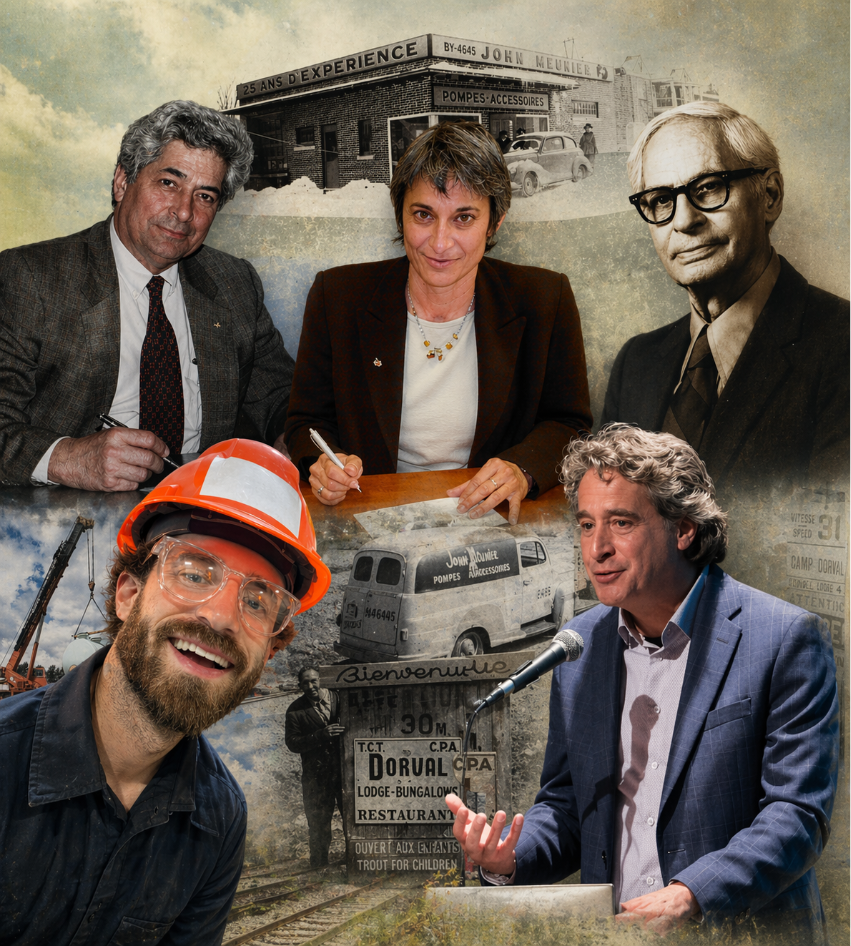
For nearly 80 years, the Meunier name has been synonymous with water treatment in Quebec. Now, a fourth generation is extending that legacy — not with pumps or imported filtration systems, but with a compact dosing module born from a young engineer’s fascination with engines.
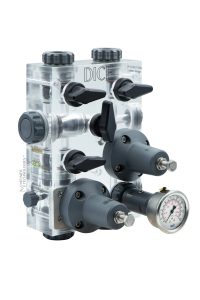
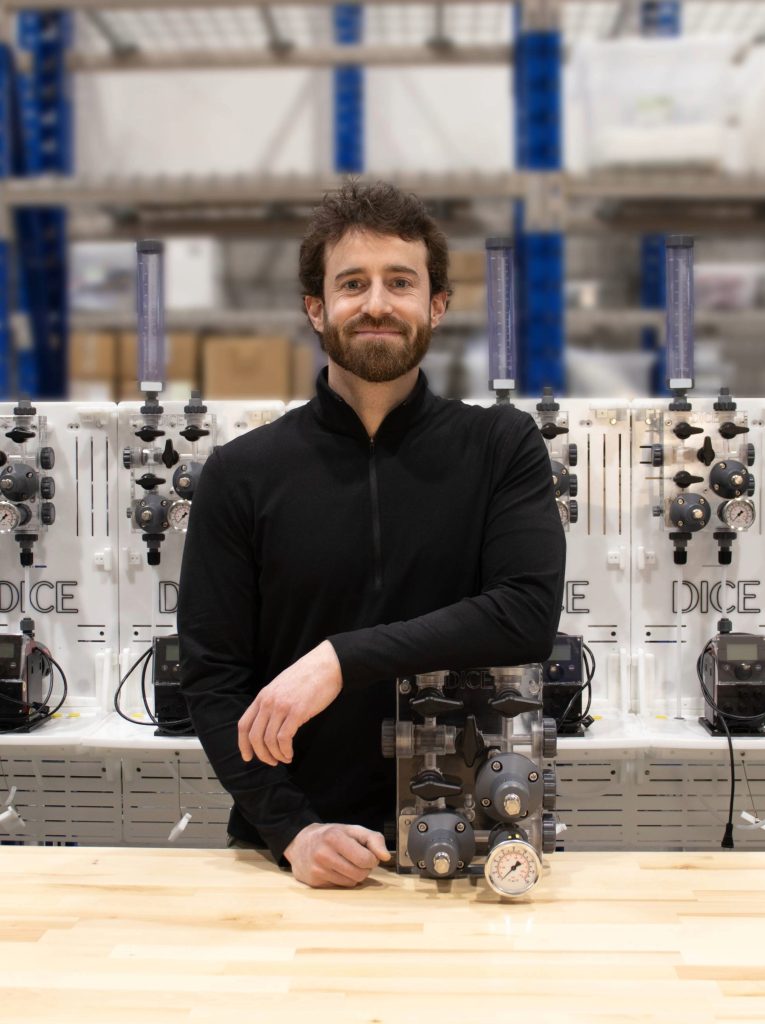
When Vincent Meunier graduated from École de technologie supérieure in 2018, he set out to solve operational challenges he had observed at a Quebec water treatment facility. Now 34, the mechanical engineer and founder of Meunier Technologies has led the development of a compact dosing module, DICE™, that integrates multiple components into a single machined block, reducing leak points, simplifying installation, and improving system reliability. He wondered if he could work to conquer the mechanical fatigue of vibration while pumping in pressurized chemicals safely inside of a reliable assembly — parts joined together by tubing or piping — and do so with fewer connections and minimal leaks from multiple joints.
Could he integrate everything and make it smaller, simply ready to mount and go?
“The concept of having everything together inside a block was compelling in my mind,” Vincent recalls. “But I knew executing this, in terms of product development, was going to be hard.”
The technology has since been installed more than 2,000 times at facilities across Europe, North America, South America, and Australia, with individual plants often deploying multiple units depending on treatment requirements.
Nearly eight decades after his great-grandfather John Meunier founded his pump repair business in Montreal, Vincent is carrying the family’s influence into a new era — one defined less by mechanical repair and more by precision-engineered innovation
Subscribe to our Newsletter!
The latest environmental engineering news direct to your inbox. You can unsubscribe at any time.
Mechanical curiosity, inherited and learned
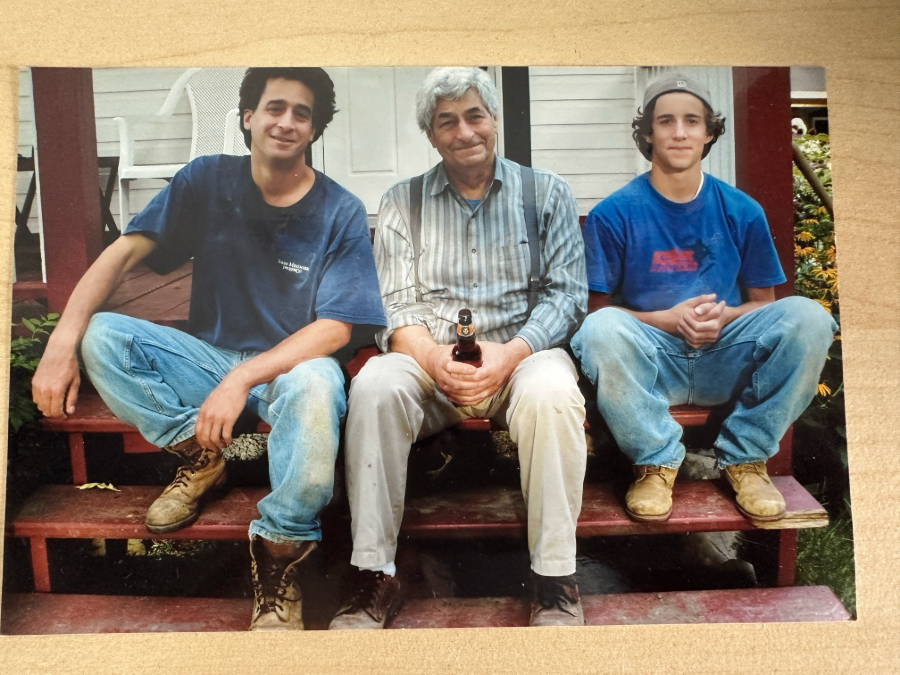
Vincent did not initially plan to enter the water sector, despite growing up surrounded by it. His father, François Meunier, and aunt, Marie Meunier, both built careers in the industry, but Vincent’s early fascination was with engines.
The family recalls his first word: “Tractor.” It foreshadowed a desire to understand the mechanical workings of engines and opened up a path to study the family’s own tractor stored at the cottage, or as it’s called in Quebec, the chalet.
“It was big and noisy, my first passion, and I was fascinated by it,” he told Environmental Science & Engineering Magazine by phone from Saint-Eustache, Quebec, where he runs Meunier Technologies.
His father remembers that curiosity vividly because his son always had an “instinctive curiosity” for mechanics. He recalls that as a child, Vincent would take apart his toys to uncover their secrets.
“As a teenager, he did not hesitate to completely dismantle the engine of one of his cars — piston in hand, his eyes shining with enthusiasm,” François says.
That instinct to understand how things worked would later shape Vincent’s engineering approach — and ultimately his contribution to the family legacy.
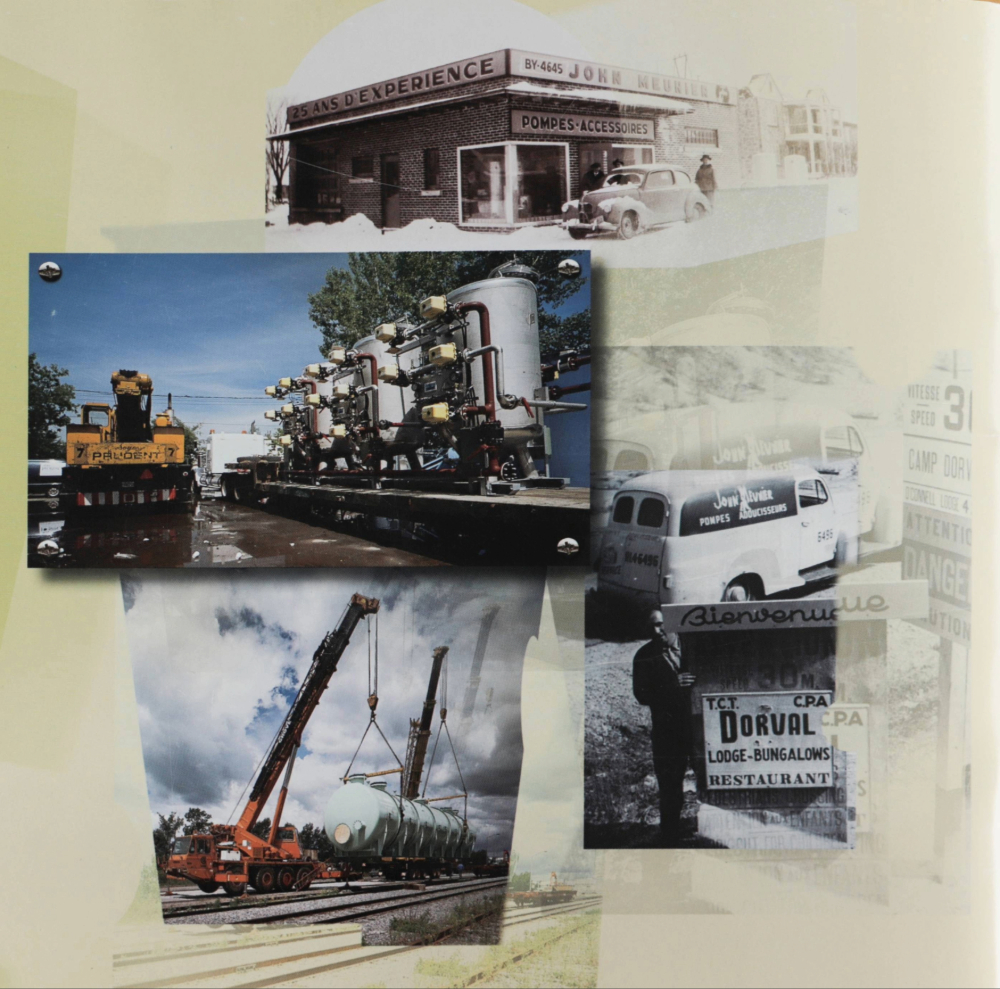
The Meunier family’s presence in water treatment began in 1948, when now notable industry figure John Meunier founded his own business after 25 years in the pump and filtration industry. Two years later, the company opened its first store, and by 1956 its property had tripled in size.
His son, Gabriel Meunier, would later lead the company through a period of modernization and expansion. After studying in Europe, where water treatment technologies were more advanced at the time, Gabriel focused on introducing innovative solutions from international manufacturers to the Canadian and U.S. markets. By the late 1990s, more than 75% of medium and large-scale water treatment plants in Quebec utilized at least one piece of process equipment or instrumentation and control system from the company. Gabriel led John Meunier Inc. (now a subsidiary of Veolia Water Technologies Canada Inc.) from 1974 to 1998, helping expand its role in wastewater and drinking water treatment.
François grew up immersed in that environment, in an apartment connected directly to the company’s pump repair workshop.
“It was through this door that the world of water treatment first opened up to me,” he recalls.
François would go on to help operate and commission wastewater treatment plants across Quebec during the province’s major infrastructure expansion in the 1980s, when hundreds of municipalities built facilities to improve environmental protection and public health. He also contributed to early mobile data collection applications used in plant operations. Now, he heads Helios Academy for training in the water sector.
The family’s influence extended beyond engineering and operations. Marie Meunier built a distinguished career in sales, marketing, and business development with John Meunier Inc. and Veolia Water Technologies Canada. She was highly involved in both the Association québécoise des techniques de l’eau (AQTE) and the Québec Water & Waste Water Association, helping guide the sector during a period of rapid growth.
Marie and Gabriel served as presidents of the AQTE — now known as Réseau Environnement — one of Quebec’s largest professional networks of environmental specialists.
Mentorship across generations
For Vincent, the connection to the industry was shaped as much by mentorship as by heritage — particularly his relationship with his grandfather Gabriel.
François recalls watching the two work side by side in the garage.
“Together, they carried out jar tests on a special settling process that Vincent had in mind. The process was ‘Top Secret,’ but I still had the privilege of witnessing this beautiful blend of passion, knowledge transfer, and creativity.”
Those experiences helped cement Vincent’s interest in engineering innovation. Gabriel’s emphasis on introducing new technologies left a lasting impression.
“The innovation portion was always in Gabriel’s DNA,” Vincent says.
From concept to company
Shortly after graduating, Vincent says he was fortunate enough to count on the help of many individuals, including his old friend Jean-Christophe Fortin Houde, also a mechanical engineer. Vincent eventually pitched the integrated dosing module for distribution in Quebec through Pumpaction Inc., securing his first commercial foothold. Early installations for DICE™ (which stands for Dosing Injection Chemical Equipment), provided valuable feedback, allowing refinements that improved performance and reliability. After some installations and more product feedback that resulted in minor fine-tuning, Meunier Technologies was about to embark on a new chapter.
One defining moment came during a trip to Toronto, when Vincent drove his aging Volvo to meet with industry distributor Greg Vissers.
“With one old bearing screaming for help,” he recalls.
The risk paid off. Significant orders were placed on the spot.
“To this day, I appreciate the audacity and tolerance to risk that Greg had,” he says. “Because at that time I was just another young professional.”
Even then, his focus remained on the work ahead.
“One thing I need to work on is being happy with the things that I achieve,” Vincent says. “Was something checked? Yes. Now the next milestone was to get enough excitement, capital, and orders to really get things started in a pretty risk-averse industry. The balance between ambition and fulfillment is difficult,” he added.
The meaning behind the work
What clicked for Vincent more recently in life was a values alignment that he had not foreseen having with the sector. He got into the line of work from an innovation standpoint, but as he got deeper into it, he was pleasantly surprised that the work was more meaningful and impactful than he had initially thought. He was seeing the water sector for the first time as a way to connect with the environment and ecology, as well as protect it, and it provided a greater sense of purpose for him and his talent for technological innovation.
“That meaning is the result of everything we are doing as a team here at Meunier Technologies, and as an industry,” says Vincent. “There is a net positive impact on the living, not only humans, but protecting the environment,” he adds, noting he also enjoys that connection to nature through rock climbing and skiing in his limited spare time.
That realization reinforced his connection not only to the sector, but to the values passed down through his family. During a trip to Germany, he met a former industry executive who had worked closely with his grandfather. The encounter revealed the depth of professional relationships built over decades. The experience was less one of business opportunity, and more one of appreciation. He saw that the CEO and his grandfather had each other’s backs, and had cultivated a relationship built on loyalty and kindness.
“That’s where I felt this legacy,” he says.
Despite that history, Vincent says he has sought to establish his own path, relying on the strength of his technology rather than his family name. Still, he has encountered a community that remembers the Meuniers’ contributions.
For his father, watching that continuation has been deeply meaningful.
“It is an immense source of pride to see Vincent carrying on the Meunier family legacy while forging his own path,” François says. “His innovative mindset, combined with his leadership and entrepreneurial skills, is already shining well beyond our borders.”
Few families can trace their influence across an industry for four generations: From John Meunier’s postwar repair shop to Gabriel’s international expansion, to François and Marie’s operational and institutional leadership.
Today, Vincent is adding his own chapter — proving that while technologies evolve, the family’s defining characteristic remains the same: A drive to innovate.
David Nesseth is a contributing editor with Environmental Science & Engineering Magazine.
This article appeared in the April 2026 print edition.




