

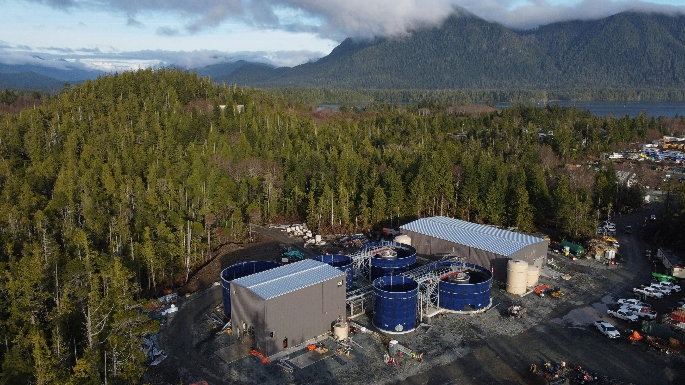
The British Columbia District of Tofino is celebrating the opening of its first ever wastewater treatment plant, a milestone that will end the small Vancouver Island tourist destination’s decades-long discharge of untreated waste into the UNESCO-designated Clayoquot Sound and the Pacific Ocean.
Following two years of construction, which included major rock blasting and land clearing, the nearly $80-million Level III WWTP received its operational certificate this summer to authorize the discharge of secondary treated and disinfected municipal sewage into the marine environment of Duffin Passage.
Tofino was the single remaining municipality on Vancouver Island to dump raw sewage into a waterway. In January 2000, Clayoquot Sound was designated as a United Nations Educational, Scientific, and Cultural Organization (UNESCO) Biosphere Reserve.
“We’re taking a massive step forward in protecting the ecosystems that surround us. We want to show other communities in Canada that are in the same boat that you can make this happen, it is possible,” said Simon Kirkland, Tofino’s Manager of Infrastructure and Capital Projects, who spoke at the plant’s official opening in late August.
Subscribe to our Newsletter!
The latest environmental engineering news direct to your inbox. You can unsubscribe at any time.
Recently, the Tofino plant completed a series of seven shutdowns and tie-ins, transferring the district’s sanitary collection system to the WWTP and allowing for the discharge of secondary treated effluent through the new outfall at the end of Cedar Street.
The new plant also successfully completed a three-day recirculation run test, ensuring that all plant equipment operates as intended. Plant staff initiated programming and controls to automate the plant, while simulating various flow conditions to ensure optimal performance, local officials announced.
When the decision was made to switch from an oxidation ditch system to Veolia Integrated Fixed Film Activated Sludge (IFAS) technology during the facility’s design process, much less space was required as the sludge thickening tanks are much smaller. This allowed the facility to complete the treatment process within two instead of four buildings, according to city staff.
The plant has two IFAS bioreactor tanks, two secondary clarifiers and the IFAS system that combines conventional activated sludge and biofilm technologies into one tank, with the tanks provided by Greatario. Influent enters through the headworks building and any increased flow is distributed to an equalization tank and then to the IFAS reactors. From the secondary clarifier, it is transferred to an inline UV disinfection system located in the facility’s mechanical building.
North American Construction (NAC) was the prime contractor and WSP was the engineering team of record for the WWTP project. Environmental services company Affordable Water Solutions has been working to train the local operators for the facility.
The small town of 2,500 residents is visited by some 600,000 tourists every year. In fact, local tourism groups made significant financial contributions to the development of the WWTP.




