

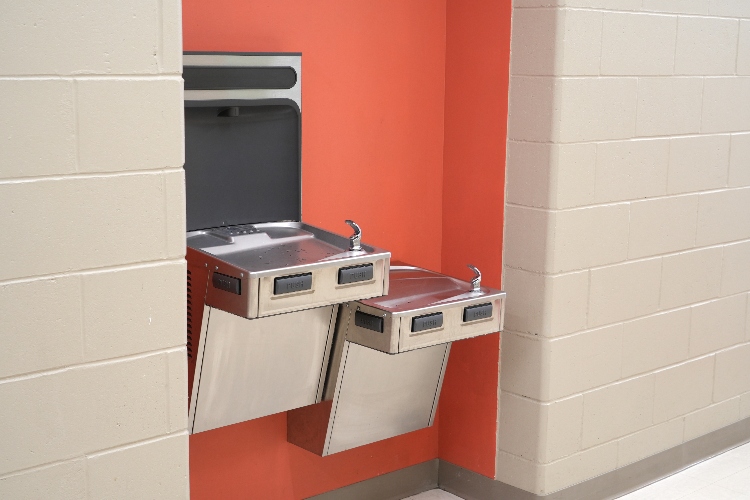
A new protocol for testing lead in school drinking water has been rolling out over the last few weeks across all Northwest Territories (NWT) JK–12 schools, establishing what the government says is a consistent, science-based approach to sampling and assessing water quality.
Some NWT schools have already tested above the Maximum Allowable Concentration (MAC) during the new round of lead testing, although mitigation work has concluded at two institutions (Range Lake North School and École William McDonald Middle School).
The territorial government intends to have all lead testing completed prior to the start of the 2026-2027 school year.
At the school where lead was most recently discovered (Kaw Tay Whee School in Dettah) in late November, six of the seven water fixtures tested are scheduled for replacement.
N.J. Macpherson continues to be under a do not consume order for its water as all 23 fixtures tested during the summer are set to be replaced.
Subscribe to our Newsletter!
The latest environmental engineering news direct to your inbox. You can unsubscribe at any time.
“As a government, our first responsibility is to protect the health and well-being of students, staff, and families. This territory-wide lead testing protocol reflects that commitment,” announced Caitlin Cleveland, NWT Minister of Education, Culture and Employment. “We will continue working with health experts, infrastructure teams, and school communities to make sure every student in the NWT has access to clean, safe drinking water.”
Developed in line with Health Canada guidance and adapted for the NWT’s unique conditions, the new protocol accounts for challenges such as remote communities, trucked water systems, and aging school infrastructure.
If lead levels exceed Health Canada’s guideline of 5 micrograms per litre, mitigation steps will be taken based on expert advice and national best practices.
Testing priorities are based on past sampling, facility age, student population, and other public health and mechanical considerations. Officials note that if staff are already travelling to a community, testing may be added even if the local school was not originally slated for early sampling.
While drinking water in NWT schools comes from regulated potable water systems, internal plumbing can still contribute trace amounts of lead. To capture the most accurate picture of potential exposure, all samples will be taken directly from the tap.
If tests identify elevated lead levels, schools will be required to take immediate mitigation measures. The Office of the Chief Public Health Officer (CPHO) will issue a drinking water advisory, and affected schools may provide alternative potable water, post “do not consume” signage, disable taps or fountains, or implement daily flushing procedures. NWT will oversee and complete any necessary remediation, with fixtures re-tested and returned to service only once results meet established guidelines.
The NWT says updates on upcoming and completed testing, as well as actions taken, will be posted online.
Quick facts
- The protocol uses a two-tier testing method to identify potential sources of lead from fixtures or internal plumbing.
- Tier 1 samples are collected after 8–24 hours of stagnation to measure lead that may leach into water overnight.
- Tier 2 samples are taken after a five-minute flush and 30-minute stagnation, reflecting typical daytime water use. Tier 2 results are the primary basis for CPHO assessment of health risk.
- Recent blood testing of 37 people connected to schools with elevated lead levels showed results within the normal range.
- Most children with lead in their blood show no immediate symptoms, though even low exposure can affect development.
- Municipal drinking water in NWT communities continues to meet regulatory requirements, and there are no concerns about lead at the source.




