


By Bradley Jenks and Fabian Papa
The April 2019 issue of ES&E magazine featured an article titled “Municipalities wanted for new water loss testing project”, which introduced an Ontario-wide water loss testing project. In recognition of the synergy between water loss reduction and energy conservation, the cross-sectoral project, led by HydraTek & Associates, is supported primarily by the Independent Electricity System Operator (IESO) through its Grid Innovation Fund.
The study involves the development and deployment of a mobile testing unit designed to accurately and reliably measure minimum night flow (MNF) into specific sectors of water distribution systems, often referred to as district metered areas (DMAs). In addition to flow monitoring, the effectiveness of pressure reduction on flow (and leakage) reduction is directly measured through the activation of a pressure reducing valve (PRV) within the mobile unit. The mobile unit has been assembled, tested and deployed at several locations in York Region and the City of Ottawa.
The project involves testing at 20 DMA sites across Ontario. Results are used in the development and application of evidence-based benchmarking metrics that can assess the performance of DMAs in municipalities across North America.
Subscribe to our Newsletter!
The latest environmental engineering news direct to your inbox. You can unsubscribe at any time.
One of the key project objectives is to increase awareness surrounding water loss reduction practices. Reducing water losses also reduces needless energy consumption associated with water lifted to overcome elevation differences, moved through piping networks which offer frictional resistance, and pressurized to provide an adequate level of service to users.
While it is still early in this multi-year project (expected to conclude in 2021), initial successes have proven the mobile DMA testing concept and substantial value has already been realized.
A compelling case for water loss reduction practices
Among the test sites thus far, of particular interest was a tested DMA located in a municipality that purchases its water at wholesale from upstream bulk suppliers. Consequently, the marginal cost of water to the municipality is rather high (relative to those municipalities that produce their own water) and at the current rate, which is trending upward. Therefore, any water loss reduction efforts would be justifiable.
From an energy perspective, the test site is situated relatively high in elevation and pressurized to operate at a hydraulic grade line approximately 155 metres above source water elevation. Furthermore, appreciable frictional losses are generated from the over 28 kilometres of transmission mains that connect the site to its supply.
Based on an average wire-to-water pumping energy consumption of 4,000 kWh/Mm3/m1, and accounting for static lift and dynamic frictional losses, the embedded pumping energy for the case study location is determined to be 0.734 kWh/m3. This is nearly double the average of the other tested DMAs. Accordingly, the selected test area is an ideal candidate to exhibit the benefits of possible energy conservation from reducing inefficiencies such as watermain leakage.
Understanding the considerable consequences to leakage in the area, the municipality had initially retained HydraTek to design and implement a permanent pressure management area (PMA). The goal was to curb pressure-dependent background losses in a sector of their watermain system, which consisted of old metallic pipe and suffered from higher-than-average history of breaks.
However, from an evidence-based perspective, no reliable site-specific data was available upon which to justify the appreciable investment of a PMA. All things considered, the characteristics and intervention intentions in the area demonstrated it was the ideal candidate test site for using the mobile testing unit as a diagnostic tool to inform further water loss reduction decision-making.
Pre- and post-leak repair mobile unit deployment
Initial mobile unit deployment occurred in mid-May of 2019. Testing took place over four nights at both full (normal system conditions) and reduced pressures. As a result, a consistent MNF was measured and is represented by the orange time series plot in Figure 1 (pre-leak repair flow). Post-processing of the data included a centralized 60-minute moving average of the MNF to eliminate random uncertainties and capture overall flow profile. The measured MNF60 relative to certain key DMA characteristics, such as the number of service connections and the average billed demand (ABD), among others, was used to populate meaningful benchmarking metrics displayed in Figure 2 (initial data point in light orange).

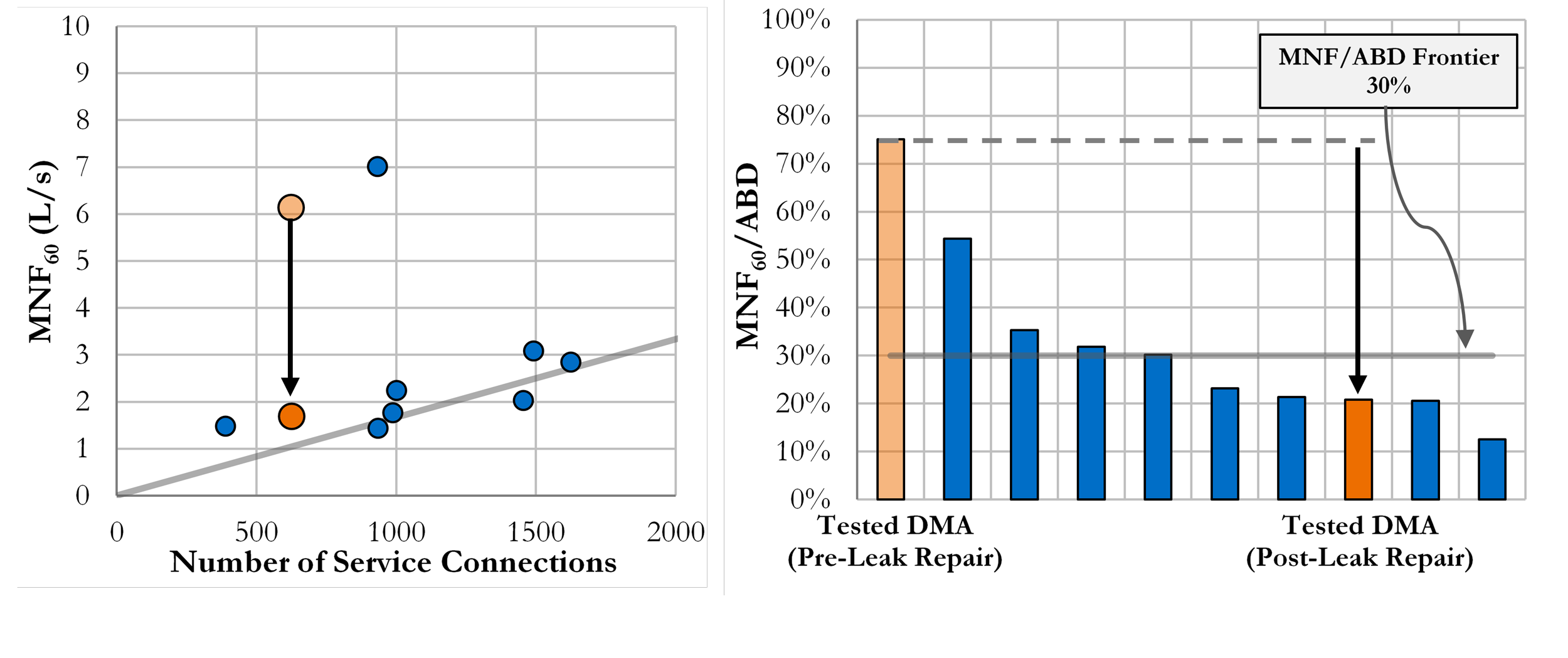
The graphs in Figure 2 also include several other tested sites as part of this project, in addition to an evidence-based MNF60 frontier which is intended to represent healthy systems with similar characteristics (i.e., predominantly residential areas in the case of this study). These benchmarking frontiers are under ongoing development as the project progresses. However, they have proven valuable and provided insightful findings thus far.
From the results, it was evident that the tested DMA’s placement in the project-derived benchmarks was notably higher than its peers. The established MNF frontier indicated strong potential for realizable water and energy savings of 39,500 m3/year, $121,000/year and 27,000 kWh/year. This equates to approximately 1.1 tonnes of CO2/year (note, estimates conservatively assumed the recovery of only 25% of the estimated excess leakage identified).
Accordingly, the municipality was informed of the DMA’s poor performance and the resulting recommendation to further investigate based on the strong business case for recoverable excess leakage. Subsequent to initial testing, and informed by the interpreted results, the municipality conducted a leak survey in the area. It found a substantial leak, which was then repaired.
Post-leak repair deployment of the mobile testing unit was done shortly after, with the objective of quantifying the recovered excess leakage as a result of the repair. The blue time series plot in Figure 1 represents the measured post-testing results, indicating a significant reduction in MNF60 of approximately 4.4 L/s. Furthermore, Figure 2 illustrates the before-intervention result and the after-intervention result (in dark orange).
Relative to both benchmarking metrics (Figure 2), the post-testing MNF60 results show that the DMA is now performing in the region of its healthier peers, verifying the reduction in leakage.
Measured water, energy and financial savings
Repairing this single leak resulted in the following measured and verified beneficial impacts to the municipality:
- Water savings: 139,000 m3/year
- Financial savings: $426,000/year
- Energy savings: 102,000 kWh/year (102 MWh/year)
- Mitigated environmental impacts: 4.1 tonnes of CO2/year (@ 40 g CO2/kWh)
To put these values into perspective, the measured water savings is equivalent to an annual consumption of about 505 typical single-family households (based on 251 L/cap/day; three persons per dwelling; and 365.25 days in a year) which amounts to nearly the size of the tested DMA.
These significant benefits were a result of informed intervention in only a small segment of the Region’s watermain infrastructure. This suggests further savings from proactive water loss management, both financially and environmentally, are reasonably attainable. More importantly, the municipality realized a further benefit by avoiding the cost associated with their originally planned PMA implementation (valued at greater than $250,000).
Additional information, including results and project dissemination is available at www.hydratek.com/mobile_dma_testing.
Bradley Jenks and Fabian Papa are with HydraTek & Associates (A Division of FP&P HydraTek Inc.). This article appears in ES&E Magazine’s February 2020 issue below.
The authors acknowledge the sponsorship of the Independent Electricity Services Operator (IESO) Conservation Fund and the National Research Council Industrial Research Assistance Program (NRC-IRAP) in addition to the participation of the Ontario Clean Water Agency (OCWA), the Ontario Water Works Association (OWWA), the University of Toronto, as well as the following municipalities and/or their water utilities (to date): Regions of Durham and York, as well as the Cities of Ottawa, Markham and Vaughan, and the Town of Georgina.




