By Kaleb Mudrik and Lindsay Jones
There is a great deal of variability in raw water screening requirements, depending on the source from which a water treatment plant (WTP) acquires its water. In the case of many plants adjacent to large bodies of water, long intake pipes that extend far from shore tend to minimize the debris experienced at the plant.
However, WTPs that draw water closer to shore can be prone to excessive fouling at their raw water intake. This can pose a particular maintenance and operation challenge when seasonal events, such as spring flooding, summer algal buildup and falling leaves in autumn, cause an increase in debris. Ontario’s Niagara Region recently undertook a project to improve the debris handling system at their Decew Falls WTP to reduce this burden on their staff.
The Decew Falls WTP draws raw water from a protected manmade drinking-water reservoir. The reservoir is fed by Lake Erie through the Welland Canal and a manmade raw water channel. The reservoir, canal and raw water channel all feature ample shorelines that produce leaves, logs and other debris, along with the typical algae and sediment.
Subscribe to our Newsletter!
The latest environmental engineering news direct to your inbox. You can unsubscribe at any time.
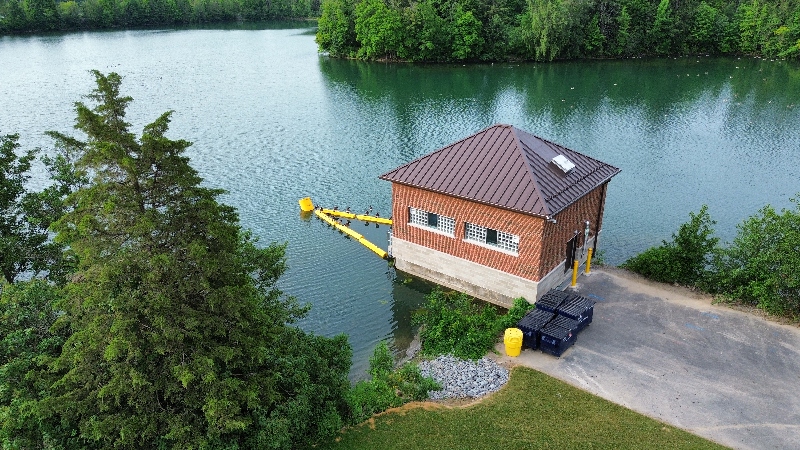
The plant’s intake building, which was constructed in 1951, is a structure built directly on the shoreline of the drinking water reservoir. A ground-level floor slab provides access to the above-water equipment, while water flows below through two intake channels and a common wet well in the concrete structure. Two 900-mm ductile iron pipes, equipped with gate valves, carry raw water north under Decew Road to the main plant property, where a below-grade channel ultimately feeds the low-lift pumps.
Floating boom with debris screens
The original design of the intake building featured a bar screen at the mouth of each channel to capture large items before they enter the building. These screens could be cleaned by operators via a rear access platform. However, this task was labour intensive and required operators to work over water.
In order to limit the accumulation of debris on the bar screens, a specialized floating boom was installed in the reservoir around the entrance of the intake channels. It is designed to deflect logs and other large items, minimizing cleaning requirements of the existing bar screens. The screen is fastened to the intake building on both sides and secured in the middle by a submerged concrete block, effectively forming a snowplow-like shape around the intake structure.
Thru flow travelling screens
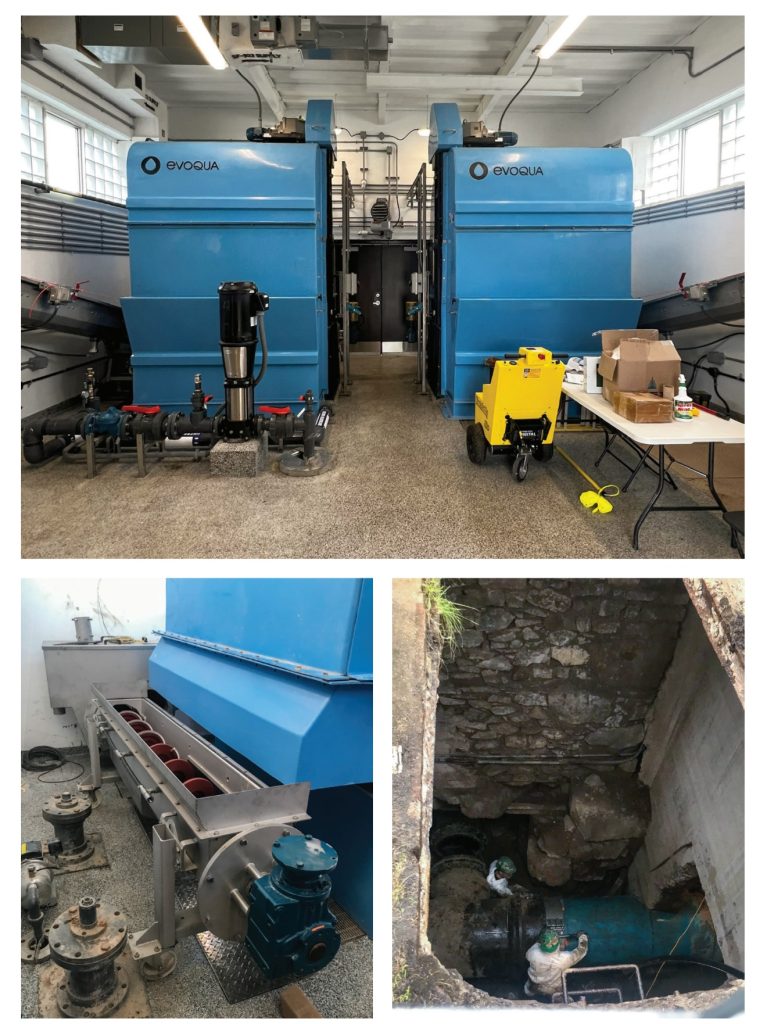
Finer debris that is not captured by the new floating boom and existing bar screen is carried into one of two intake channels under the building. Each channel is equipped with a new thru flow travelling screen, which have replaced existing travelling screens that were nearing end of service. The existing wash-water pump was also replaced to supply high-pressure water to the cleaning nozzles of the new screens.
The thru flow travelling screens consist of a series of overlapping screen baskets fastened to a rotating chain/sprocket assembly. There are 10-mm square openings in the mesh, which allow water to flow easily through the channel while depositing solids into the baskets.
Ultrasonic level sensors upstream and downstream of each screen measure the level differential, which can indicate excessive fouling of the screens. Both screens were integrated into the plant’s SCADA system, allowing remote operation and monitoring of the screens. The baskets are automatically rotated and cleaned with high-pressure water at a regular interval, or more frequently if significant debris causes the level differential to exceed a range set by the operator.
Screening handling conveyors
The existing thru flow travelling screens at the Decew Falls facility discharged collected refuse into a concrete trough built into the floor slab. Limited debris storage capacity and unpleasant manual cleaning of the troughs were among the complaints from plant staff. To reduce the frequency and extent of operator intervention, the new thru flow travelling screens are now designed to discharge directly into screening handling conveyors.
Two independent screw-conveyor trains each serve the purpose of dewatering, transporting and depositing the screenings into rolling waste-disposal bins. Operators may now roll the bins to the exterior of the building.
Building improvements
In addition to the process upgrades, the project also included improvements to other elements of the intake facility. All existing electrical equipment was replaced and upgraded as required to meet the new loads, including new panels, disconnects and LED lighting. Existing electric unit heaters were replaced, and a new ventilation and dehumidification system was installed to better manage the moist environment.
Upgrades were also made to the controls and site security system, including installation of a new fibreglass PLC enclosure and updated SCADA software.
Architectural features were also upgraded, including a new peaked metal roof, doors, glass block windows and brick façade, all carefully selected to improve visual cohesion with the main plant’s facilities.
Structural upgrades at the intake building included minor concrete repairs, new ladders, platforms and handrails, as well as new hatches designed to better facilitate future maintenance activities. The project also included decommissioning of nearby valve chambers that were built well over a century ago. Engineered cellular grout was used to fill the chambers, reducing risks associated with the now obsolete structures.
Results
Staff have reported a reduction in manual cleaning of the bar screens and inside the facility, as well as reduced equipment downtime. Additional instrumentation and integration with SCADA have further led to operators’ confidence in their system and ability to intervene remotely as required.
Construction on the project was completed in the spring of 2024. The general contractor was North America Constructors Ltd. Engineering design and construction services were provided by R.V. Anderson Associates Limited.
Kaleb Mudrik is with R.V. Anderson Associates Limited. Email: kmudrik@rvanderson.com. Lindsay Jones is with Niagara Region. Email: lindsay.jones@niagararegion.ca
This article appeared in the August 2025 edition of Environmental Science & Engineering Magazine.