Aiming to transform how communities monitor drinking water, researchers at the University of Chicago’s Pritzker School of Molecular Engineering and Argonne National Laboratory have developed a handheld sensor capable of testing for and detecting trace PFAS levels in water in just minutes.
Described in the September 25 edition of Nature Water, the researchers say they can detect per- and polyfluoroalkyl substances (PFAS) at concentrations as low as 250 parts per quadrillion, a sensitivity that far exceeds the U.S. Environmental Protection Agency’s (EPA) proposed drinking water limits of 4 parts per trillion for two of the most harmful PFAS, perfluorooctanoic acid (PFOA) and perfluorooctanesulfonic acid (PFOS).
“Existing methods to measure levels of these contaminants can take weeks and require state-of-the-art equipment and expertise,” said Junhong Chen, Crown Family Professor at UChicago PME and Lead Water Strategist at Argonne, in a media statement. “Our new sensor device can measure these contaminants in just minutes.”
While it can be difficult to detect these synthetic chemicals used in products ranging from nonstick cookware and firefighting foam to raincoats and food packaging, the current laboratory gold standard is considered liquid chromatography/tandem mass spectrometry. The research team says the method is expensive, time-consuming, and not suited for rapid field use, so they sought to develop a portable alternative that could deliver PFAS water testing results on the spot.
Subscribe to our Newsletter!
The latest environmental engineering news direct to your inbox. You can unsubscribe at any time.
The UChicago approach uses nanoscale probes attached to a silicon chip. When a PFAS molecule binds to the probe, it alters the chip’s electrical conductivity, allowing the sensor to quantify the concentration of the chemical.
Designing a probe specific to each PFAS type was a major challenge. To achieve this, the researchers used machine learning to predict which molecular probes would best recognize particular PFAS signatures.
“Computer simulations and machine learning have proven to be an incredibly powerful tool to understand how these molecules bind to molecular sensors,” said Andrew Ferguson, Professor of Molecular Engineering at UChicago, in a media statement. “They can guide experimental efforts to engineer more sensitive and selective probes.”
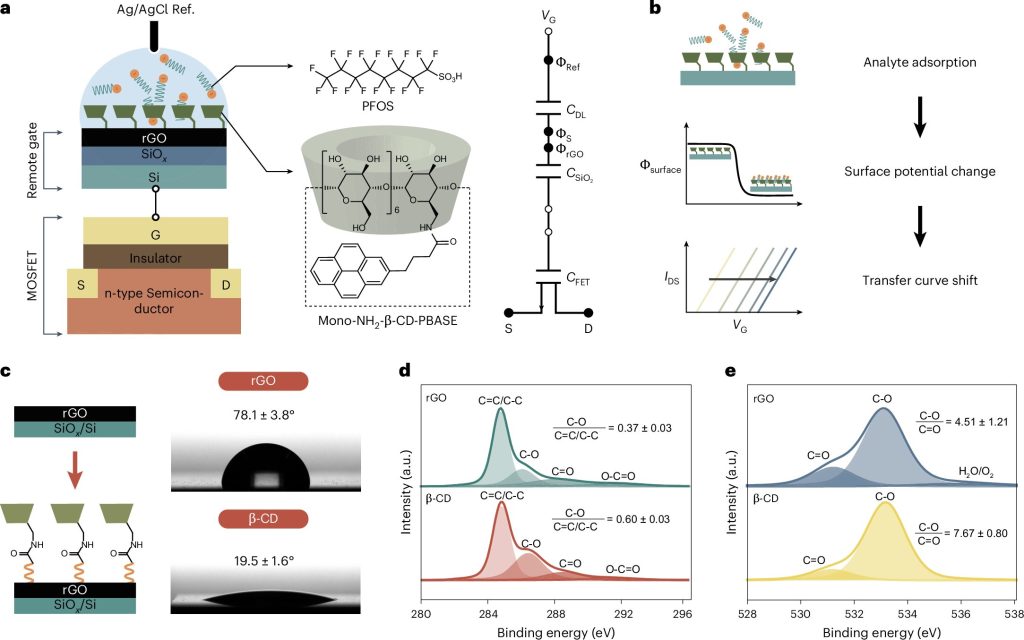
In laboratory tests, the device accurately detected PFOS even in water containing other common chemicals at much higher concentrations. The results were validated in collaboration with the EPA using standard laboratory methods. The sensor also maintained its accuracy after repeated use, suggesting it could support real-time water monitoring.
The project builds on more than a decade of work by Chen’s group to create highly sensitive, chip-based water sensors. His team has previously applied similar technology to detect lead in drinking water and is now part of the National Science Foundation’s Water Innovation Engine in the Great Lakes region.
“Our next step is to design new probes for other PFAS compounds and scale up the technology,” Chen said. “Ultimately, we envision this as a tool that could allow consumers to test their own water and make informed choices about their environment.”