


Dalhousie University researchers are piloting what may be the world’s first municipal-scale UV LED reactor for wastewater treatment, which they say could replace the energy-intensive mercury vapour bulbs that dominate the industry.
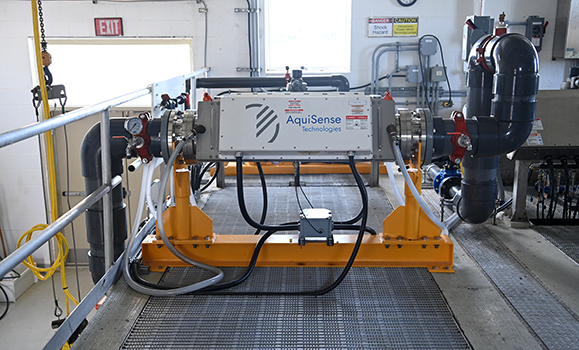
Halifax Water is also studying LED technology in collaboration with Dalhousie engineering researchers and AquiSense, the project’s industrial UV LED partner and supplier.
“The bulbs produce a lot of heat, and in a wastewater system, you can imagine there’s a lot of material in the water that builds up on them as a result, causing fouling,” says Halifax Water’s acting director of environment, health and safety, Dr. Wendy Krkosek, speaking about mercury. “And so, there’s a very large operation and maintenance cost in cleaning the bulbs. It’s a significant burden on operations.”
The researchers also note that the UN Environment Programme’s Minamata Convention will put a stop to mercury mining by 2032, interrupting the supply needed by industry. The European Union banned the use of the chemical element, only making an exception for wastewater treatment due to a lack of alternatives.
Subscribe to our Newsletter!
The latest environmental engineering news direct to your inbox. You can unsubscribe at any time.
Even when they are permitted, the researchers say that responsibly disposing of mercury bulbs is costly and complicated. As a result, they often end up stockpiled, racking up storage costs, along with potential risks.
Enter LEDs, the tiny points of light-emitting diodes that make up our screens and many modern illuminated environments. They are also the light source that water scientist Graham Gagnon and his research project colleagues, Amina Stoddart and Sean MacIsaac, want to see as a feasible replacement for mercury bulbs.
Gagnon, director of Dalhousie’s Centre for Water Resources Studies, explains that, unlike mercury vapour bulbs, which emit light and heat in all directions, UV LEDs are far more “disciplined”. They direct light one way and radiate heat the other.
“This means that as wastewater flows past the thousands of tiny diodes in a UV LED reactor, it is bathed in pure, targeted UV light without the high temperatures that lead to the buildup of effluent that fouls traditional mercury bulb systems,” explained the researchers in a statement.
In 2019, Gagnon took a single-diode unit to Nunavut for field research, which kindled a stronger interest in the technology. Now, he’s working with an NSERC Alliance Advantage grant to explore scaling up systems to meet the needs of drinking water disinfection at municipal and industrial levels. The researchers worked with Halifax Water to make the larger system a reality, teaming up with the utility to install and operate it at its Eastern Passage wastewater treatment facility.
The reactor has been integrated into the utility’s infrastructure since January 2024, allowing it to function at a municipal scale over an extended period of time. Students collect samples working alongside Halifax Water employees and allowing researchers to closely study its efficiency, both in terms of its ability to disinfect water and the energy required to do it.
Their findings, published in the most recent edition of the journal, Water Research X, are positive, proving for the first time the ability of a UV LED system to meet the needs of municipal water disinfection.
Krkosek says the UV LED reactor is working so well that it’s difficult to know exactly how much power is actually needed for it to get the job done. The goal now is to find the sweet spot for operating the reactor with the least amount of power and greatest volume of water to achieve full disinfection without wasting energy, she says.
“Our research shows that we are using energy much more efficiently and so that will be much better from a greenhouse gas emission standpoint,” says Gagnon. “We don’t use any harmful chemicals, we consume less CO2, we consume less space, and we can deliver the same volume of water with at least the same quality, if not better.”




