

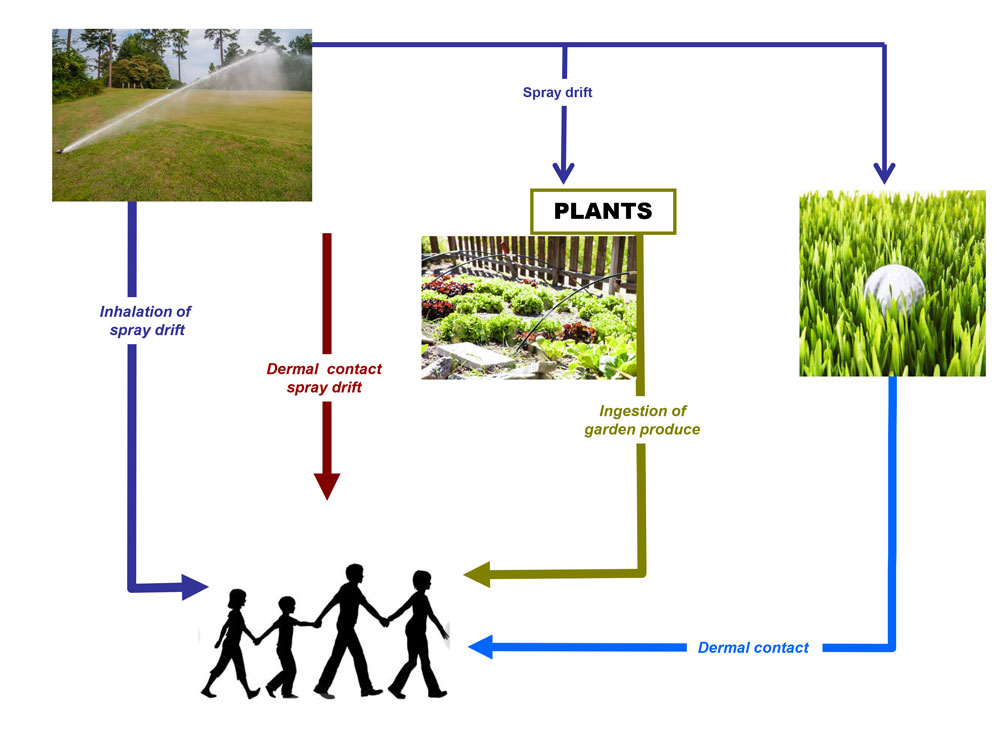
Water quality criteria that were of relevance to the use of reclaimed wastewater or surface water to irrigate agricultural crops were considered for the purposes of evaluating the potential risks. To evaluate potential risk associated with direct skin contact and inhalation of aerosols, and exposures to cyanobacteria and related toxins, the proposed water quality was screened against “recreational” water criteria and water quality criteria of relevance to parklands and landscapes, as defined in the guidelines.
- In general, the quality of the proposed Harmony reclaimed water met, or was superior to, the requirements of the regulatory agencies for various uses including:
- Direct ingestion via food crops.
- Indirect ingestion or skin contact with recreational water (e.g., swimming, bathing in surface waters or impoundments).
- Indirect ingestion or skin contact that may arise as a result of wastewater irrigation on parklands, playgrounds, golf courses, landscaping, etc.
- Incidental inhalation associated with recreational or agricultural uses.
A few parameters in the proposed Harmony wastewater were found to slightly exceed relevant guidelines:
- Proposed maximum E. coli levels after the treatment plant and post-storage disinfection were higher than the interim ESRD and Canadian Council of Ministers of the Environment (CCME) agricultural water quality guidelines. However, based on the information available, it is not clear if the ESRD/CCME value was intended for fecal coliform or E. coli, or both. Proposed E. coli levels met several other agricultural, landscaping and recreational criteria.
- Proposed turbidity of the reclaimed water (at the treatment plant) was found to be greater than what is required in the California Title 22 Requirements for tertiary water reuse. A recent critical review of the California regulations for recycled water completed by the National Water Research Institute (NWRI 2012) found that the turbidity requirements were in need of additional clarification.
The proposed turbidity at the treatment plant for the reclaimed water met the U.S. EPA water reuse guideline for the irrigation of raw edible produce. Regular monitoring of the turbidity of the water in the storage pond prior to irrigation use was recommended as a mitigation measure.
- Proposed residual chlorine after the second disinfection point, post-storage, was estimated to be lower than what is required by the U.S. EPA Guidelines for Water ReUse (2012) for agricultural irrigation and landscaping uses. These are >1.0 mg/l compared to the proposed limit of >0.5 mg/l. However, chlorine is of concern for aquatic organisms, and the CCME has devised a water quality guideline for the protection of aquatic life of 0.5 mg/l for reactive chlorine species.
There is potential for surface run-off from irrigation to impact surface water quality in the area. Therefore, consideration of the potential impacts on aquatic life from a chlorine residual greater than 0.5 mg/l should be balanced with the interpretation of the U.S. EPA water reuse criterion of 1.0 mg/l or greater chlorine residual for protection of human health.
Subscribe to our Newsletter!
The latest environmental engineering news direct to your inbox. You can unsubscribe at any time.
Intrinsik also recommended that the chlorine residual at the post-storage disinfection point be adjusted, as needed, to maintain an adequate disinfection capacity (e.g., adjusted in relation to turbidity of storage pond water or other factors).




