

By Jeff Peeters and Olav Natvik
The Hespeler Wastewater Treatment Plant (WWTP) in Cambridge, Ontario, is one of 13 plants serving the more than 600,000 residents of the Region of Waterloo, one of the fastest growing communities in Canada. To help meet its projected growth, the Region needed to upgrade the Hespeler WWTP.
Rated for 9.32 MLD, the major components of the Hespeler WWTP include a raw sewage pumping station, grit channels, extended aeration (EA), chlorination and de-chlorination, as well as sludge storage with trucking for off-site stabilization and disposal.
The first stage of treatment upgrades includes new screening/grit removal, a new secondary clarifier, and converting the plant’s existing sludge storage to enable on-site aerobic digestion. As partner to the Region of Waterloo, engineering consultant Stantec is leading the Hespeler process upgrades.
Subscribe to our Newsletter!
The latest environmental engineering news direct to your inbox. You can unsubscribe at any time.
While the first phase of improvements was underway, the Region of Waterloo became interested in the prospect of a newer technology used for secondary treatment upgrade. With an eye to the future, the Region conducted a parallel study to evaluate the merits of installing membrane aerated biofilm reactor (MABR) technology to “future-proof” their site and meet imminent ammonia effluent limits.
The study concluded that MABR technology would improve nutrient removal and deliver significant capital cost and process aeration savings. With smaller tanks and a modular design, it would also preserve on-site space and allow future treatment capacity in a compact footprint to be added.
MABR overview
MABR technology can upgrade conventional activated sludge plants for nutrient removal and capacity expansion by installing MABR cassettes into an activated sludge reactor. A biofilm grows on the MABR media surface, which increases the total biomass inventory in the system, while maintaining the same suspended growth mixed liquor concentration. This enables a treatment plant to do more work in a given bioreactor volume.
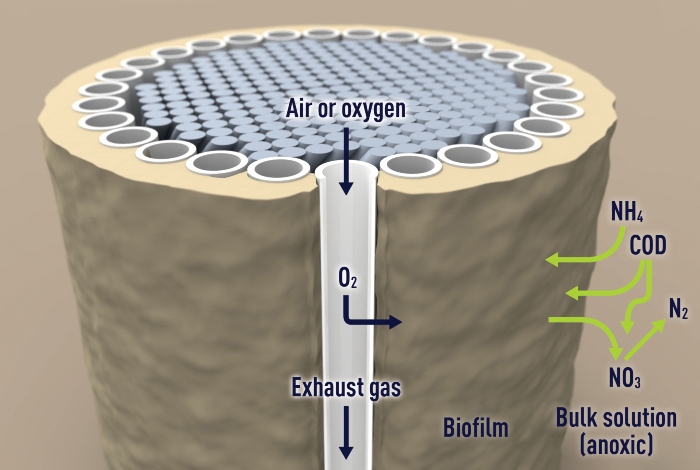
The innovation behind MABR is that it employs a gas permeable media to deliver oxygen to the biofilm that is attached to the media surface. Oxygen is delivered through the media by molecular diffusion—without the use of bubbles.
Conventional wastewater treatment is an energy intensive process, with 60% of the energy consumed by blowers to deliver bubbles that provide the oxygen necessary for the biological process. The use of bubbles for oxygen transfer can be inefficient, with 80% – 90% of the oxygen delivered by the blowers sometimes leaving the system unused.
MABR technology delivers oxygen without bubbles and reduces the energy required for oxygen transfer by up to four times. This feature allows plants that employ MABR to significantly reduce their energy footprint.
The ZeeLung product from SUEZ Water Technologies & Solutions is a supported hollow fibre configuration with multiple gas transfer membrane filaments oriented around a structural support that forms a robust cord construction.
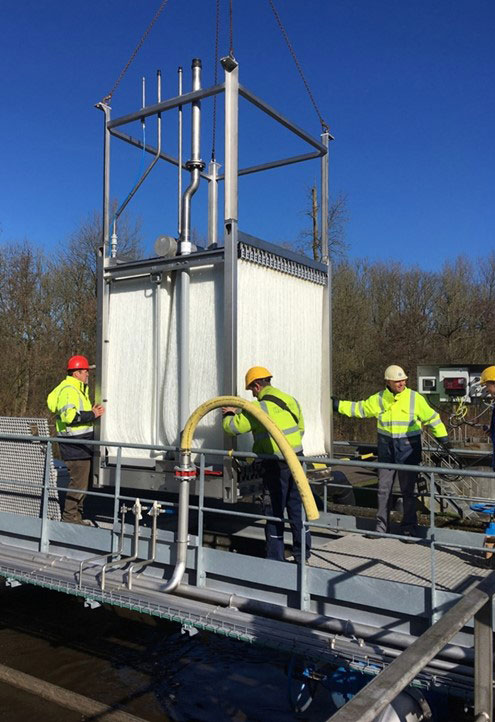
Multiple cords are potted into a top and bottom header to create a module and a series of modules are installed in a stainless-steel cassette. This forms the modular building block for an MABR system.
Low-pressure air is delivered to the cassette using typical process aeration blowers. It is distributed down the length of the ZeeLung filament lumens, where oxygen is transferred through the media to satisfy oxygen demand in the biofilm.
The remaining “exhaust” air is collected and used to mix the cassette via a coarse bubble aeration grid that is integral to the cassette. This mixing provides sufficient energy to renew substrate at the biofilm surface and slough off excess biomass to control biofilm thickness.
An additional feature of the MABR process is the ability to do simultaneous nitrification and denitrification. By installing ZeeLung cassettes in the anoxic zone of an activated sludge system, ammonia can be nitrified under aerobic conditions in the biofilm and nitrate can be reduced to nitrogen gas in the anoxic conditions of the suspended biomass around the cassettes. The advantage of this is intensifying nitrogen removal and reducing or eliminating the need for recycle pumping.
MABR study and feasibility assessment
During 2017 and 2018, the Region of Waterloo investigated the design considerations, long-term performance, and economic viability of installing MABR technology.
A pilot study was carried out to confirm wastewater characteristics, estimate MABR media area requirements for meeting effluent ammonia targets, and calculate oxygen use and electrical efficiency. The study provided data to two major vendors for preparing bid preselection tenders.
Conceptual design
A conceptual design for the MABR system was developed to ensure that adequate design flexibility was available to enable future MABR integration. The two-phase MABR expansion concept included:
• Selecting “finer” 2-mm screens (the plant does not have primary clarifiers).
• Reserving sufficient space for MABR-related tanks and equipment.
• Providing sufficient hydraulic head and interconnections to allow gravity flow.
MABR process modelling
The MABR process was modelled to estimate aeration savings against the current configuration (traditional EA operation). As part of the work, a biofilm model representation of MABR was developed to estimate the biological oxygen reductions and basis for electrical savings.
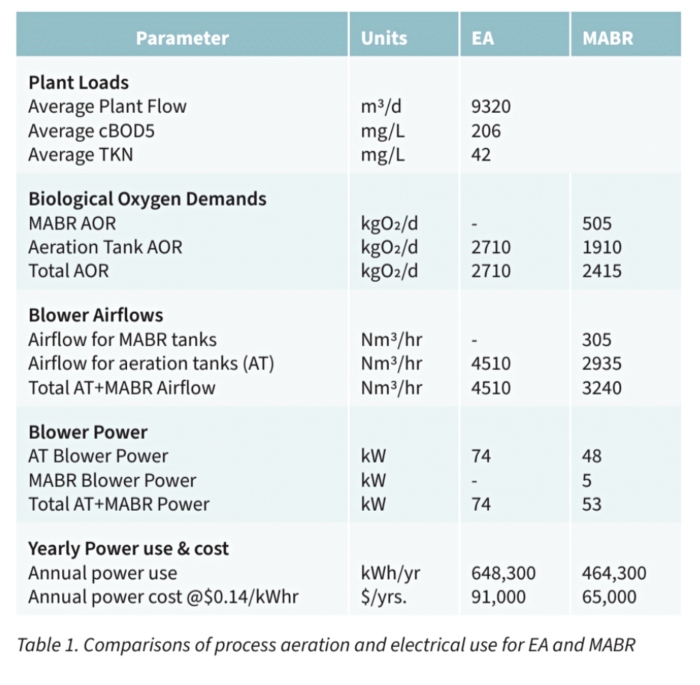
According to the model, process aeration savings greater than 30% are anticipated, compared to EA. Modelling and aeration estimates are shown in Table 1.
Construction cost evaluation
To compare the anticipated construction costs of MABR versus EA, conceptual designs and construction cost estimates were completed for both EA and MABR processes under a 9.32 MLD continuous nitrification scenario.
The results showed that an MABR design would cost significantly less than upgrading with EA, with the estimated capital expenditures for MABR and EA at $6 million and $11 million, respectively.
Similar MABR construction cost savings are expected when the plant is expanded beyond its current rated 9.32 MLD capacity. The majority of the savings under a future expansion come from the system’s smaller process footprint compared to that for an EA expansion.
The results of the MABR study and feasibility assessment revealed two key cost-saving benefits:
• An electrical savings of greater than 30% for process aeration. The savings are due to the high efficiency bubble-less oxygen transfer of MABR technology.
• Capital cost savings of approximately 50% compared to a traditional EA design due to the ability to retrofit into smaller tanks.
Developing an MABR design
Toward the latter part of 2019, the Region of Waterloo secured funding from the Federation of Canadian Municipalities’ Green Municipal Fund to support the implementation of MABR technology at the Hespeler WWTP.
In June 2020, a detailed design for the MABR system was completed. SUEZ was commissioned to supply all associated MABR equipment, including ZeeLung cassettes, process aeration equipment, and instrumentation and controls. The general contractor would construct four concrete MABR tanks and install the vendor-associated equipment as part of the ongoing construction contract.

For engineering considerations, it was decided to construct new purpose-built tanks, rather than retrofit into existing tankage. The decision was based on simpler construction staging and commissioning, poor existing tank retrofit characteristics, as well as the opportunity to “isolate” the MABR from mixed liquor influence and assist its performance testing metrics. A process flow diagram of the MABR system is shown in Figure 1.
MABR performance requirements drove a design basis for flows and loads as well as final effluent limits. A high-level nitrogen balance was performed to estimate tank process effluent NH3-N reduction that would be necessary to ensure final effluent limits were maintained. The nitrogen mass balance considered raw sewage loading, biomass assimilation, and final effluent NH3-N limits, and assumed a worst-case scenario with non-nitrifying activated sludge process during winter operation.
Calculations suggest MABR tank process effluent NH3-N must be less than 12 mg/L as monthly average to ensure final effluent NH3-N limits are maintained. Therefore, MABR tank effluent NH3-N < 12 mg/L as monthly average was specified for all operating conditions.
Design elements of the final MABR system include:
• An inlet valve chamber to allow flow control of MABR bypass of raw sewage and/or return activated sludge.
• Influent flow splitter box with jet mixing and nozzles extending into blank cassette spaces.
• Four parallel MABR tanks, each containing nine ZeeLung cassettes and two blank spaces to allow future cassette integration.
• Hydraulic provision to raise cassettes 600 mm should internal cassette MLSS mixing prove inadequate.
• On-line instrumentation (flowmeters & analyzers) to facilitate commissioning, research, testing and confirm MABR performance.
Embracing a new approach
Through their willingness to break with conventional methods and investigate an alternative technology for secondary treatment, the Region of Waterloo was able to fully understand the unique value proposition of incorporating MABR technology at the Hespeler WWTP.
The findings of the MABR study and feasibility assessment demonstrated that the upgrade would significantly improve effluent quality while reducing the plant’s energy consumption.
Importantly, the Region of Waterloo’s conceptual design also established that the MABR system could be built and installed at a lower capital cost, both now and when the plant is expanded in the future. Additionally, the compact footprint of the MABR design preserves space at the plant and the modularity of the technology allows the Region to pace its investment at the Hespeler WWTP in terms of meeting future capacity needs.
The MABR system is currently under construction and will be operational by the end of 2021.
Jeff Peeters is with SUEZ Water Technologies & Solutions. Email: jeff.peeters@suez.com
Olav Natvik is with Stantec Consulting Ltd. Email: olav.natvik@stantec.com
Read the full article in ES&E Magazine’s April 2021 issue:




