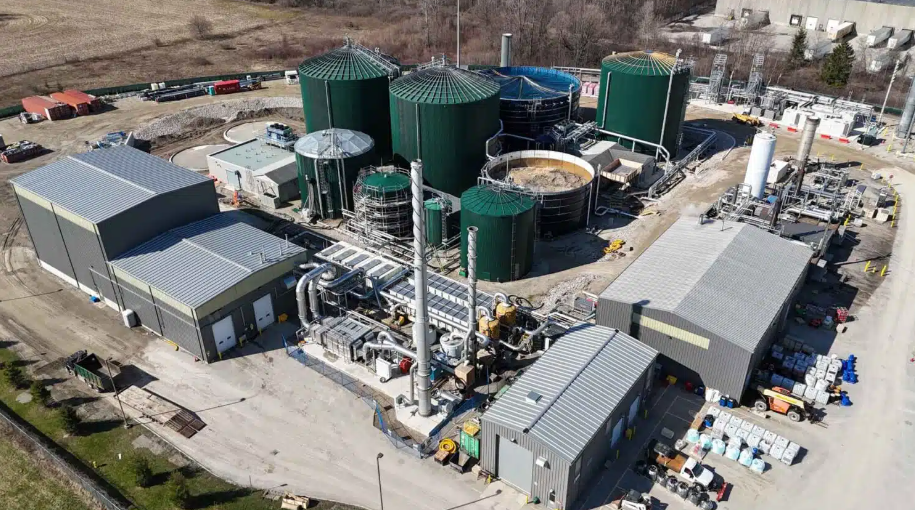
The federal government is investing nearly $19 million to expand an anaerobic digestion facility in London, Ontario, where food and organic waste is converted into renewable natural gas (RNG) and fertilizer.
Canada’s Natural Resources Minister Tim Hodgson announced the funding for StormFisher Environmental Ltd., a subsidiary of Generate Upcycle, to increase production capacity at its London Anaerobic Digester & Biogas Plant.
Generate Upcycle president Bill Caesar said federal support was important to advancing a broader $70-million expansion of the facility.
“Natural Resources Canada’s investment through the Clean Fuels Fund was integral to making this expansion possible,” said Caesar, whose company operates a network of 12 anaerobic digestion facilities across the U.S., Canada, and the U.K. that convert commercial, industrial, and municipal food waste into RNG and organic fertilizer. “Public-private partnerships like this play an important role in scaling clean energy infrastructure,” he added.
Subscribe to our Newsletter!
The latest environmental engineering news direct to your inbox. You can unsubscribe at any time.
The facility processes municipal source-separated organics as well as food and beverage waste from industrial, commercial and institutional sources. According to the federal government, it is the largest food waste anaerobic digestion facility in Canada producing RNG from these waste streams.
The federal funding is being provided through Natural Resources Canada’s Clean Fuels Fund and will support the broader expansion.
Once the expansion is completed in 2027, the London Digester Plant is expected to have the capacity to produce an additional 450,000 gigajoules (GJ) of RNG annually, which the federal government estimates is enough energy to power approximately 4,500 homes. The facility’s total RNG production capacity is expected to reach 675,000 GJ annually.
The project is also expected to produce an additional 86,000 tonnes of nutrient-rich organic fertilizer each year for use on farms in southwestern Ontario.
Anaerobic digestion uses microorganisms to break down organic material in the absence of oxygen, producing biogas that can be upgraded into RNG. The process also produces digestate that can be used as an agricultural fertilizer.
The federal government says increasing RNG production can help reduce greenhouse gas emissions while diverting organic material from landfills and producing a domestic source of lower-carbon fuel.
“By supporting projects like Generate Upcycle’s RNG facility, we are leveraging homegrown innovation and existing resources into reliable, low-carbon energy while growing domestic clean fuel production and creating jobs,” Hodgson said in a statement.
The federal Clean Fuels Fund supports capital investment in new and expanded clean-fuel production facilities, along with feasibility and engineering studies, biomass supply chains and work related to clean-fuel codes, standards and regulations.