

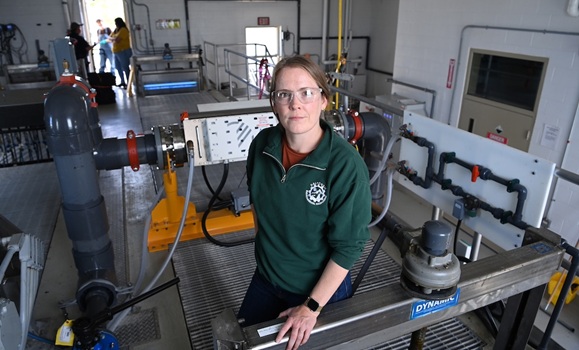
Researchers at Dalhousie University are launching a new initiative to develop advanced monitoring and treatment technologies aimed at helping communities respond to growing water risks linked to climate change.
With support from the Canada Foundation for Innovation (CFI), Drs. Graham Gagnon and Amina Stoddart of Dalhousie’s Faculty of Engineering will lead the development of the Water RESILIENCE Lab. The project will focus on detecting water-quality changes more rapidly and developing energy-efficient treatment technologies as climate pressures, emerging contaminants and aging infrastructure increasingly challenge Canada’s freshwater systems.
The funding is part of a larger announcement made March 13 by the CFI, which awarded more than $7.3 million to Dalhousie University through its Innovation Fund to support four major research infrastructure projects.
“Investing in this research safeguards Canada’s water resources, supports actionable science for communities, and positions the country as a global leader in climate-resilient water stewardship,” said Stoddart, Dalhousie’s Canada Research Chair in Wastewater Treatment Technology and Surveillance in a statement.
Subscribe to our Newsletter!
The latest environmental engineering news direct to your inbox. You can unsubscribe at any time.
The lab will be equipped with automated genomic and flow cytometry systems, high-resolution mass spectrometry and ultraviolet LED disinfection systems. Researchers will use these technologies to track climate-driven changes in watersheds, identify emerging contaminants and design low-carbon approaches to remove pollutants such as PFAS and waterborne pathogens.
The Water RESILIENCE Lab received a CFI award of $1.37 million toward a total project cost of $3.43 million.
“State-of-the-art research infrastructure is essential for tackling the complex challenges facing our communities and environment,” said Gagnon, Dalhousie’s vice-president of research and innovation. “These investments equip our research community with the tools they need to generate new knowledge, train highly skilled talent and work with partners at home and around the world to deliver solutions that benefit Canadians.”
Studying the ocean’s role in climate
Another project will examine how the ocean stores and cycles carbon in a rapidly changing climate.
Led by Erin Bertrand and Carolyn Buchwald of Dalhousie’s Faculty of Science, the research initiative — Quantifying the ocean carbon climate system in a changing world — will build laboratory infrastructure to study how the ocean absorbs and stores carbon and how that capacity is evolving.
“The ocean absorbs much of the carbon dioxide humans release, but many of the processes that make this possible are not well understood,” said Bertrand, who recently became acting scientific director and CEO of the Ocean Frontier Institute. “This new infrastructure gives us the ability to examine those processes in much greater detail and to generate evidence that governments and communities can rely on when making decisions about climate action and ocean stewardship.”
Research will focus on the Northwest Atlantic, the Arctic Gateway and the St. Lawrence system, regions experiencing rapid environmental change and playing an outsized role in ocean-climate interactions.
Ocean tracking network upgrades
CFI funding will also support new infrastructure for the Ocean Tracking Network (OTN), a globally recognized aquatic research organization headquartered at Dalhousie.
The project, led by Robert Lennox and Sarah Fortune, will renew and upgrade key infrastructure used to track marine animal movements and monitor ocean conditions. For nearly two decades, OTN has deployed monitoring technologies, including electronic tags, acoustic receivers and autonomous ocean-going robots, in marine and freshwater environments around the world.
“OTN brings together researchers around the world who are working to understand how aquatic animals move through and interact with marine ecosystems,” said Lennox, the network’s scientific director. “Upgrading this infrastructure strengthens Canada’s ability to lead that global effort and to turn ocean observations into knowledge that supports responsible management of the ocean and related industries.”
The project received a CFI award of $2.62 million toward a total cost of $6.67 million, with matching funding from Fisheries and Oceans Canada and in-kind contributions from equipment manufacturers.
Another related project focused on ocean research infrastructure has received a CFI award of $3.02 million toward a total project cost of $7.55 million and will be conducted in collaboration with Université du Québec à Rimouski.
Together, the projects aim to strengthen Canada’s capacity to study climate change impacts on water systems — from drinking water supplies to marine ecosystems — while equipping researchers with new tools to support evidence-based environmental management.




