

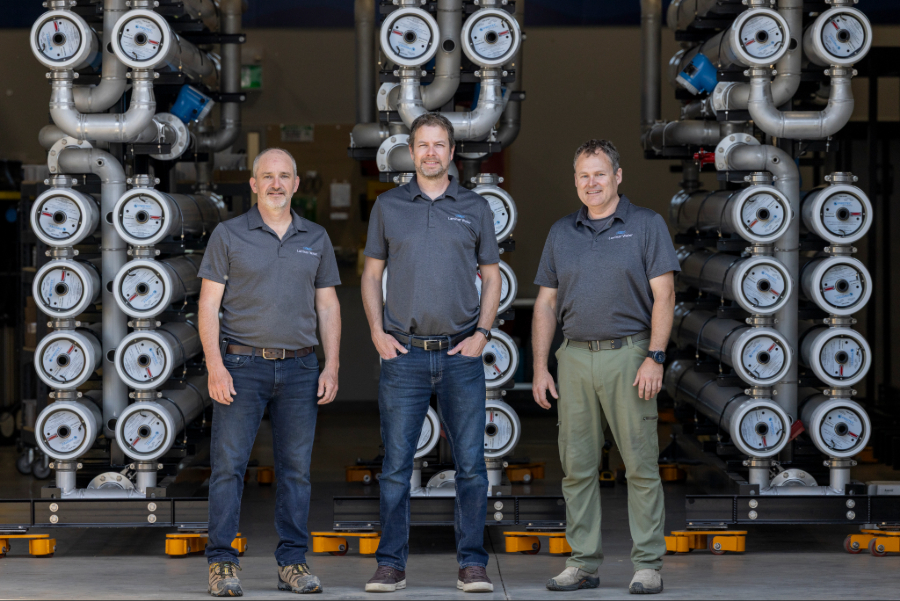
What was once brown, discoloured drinking water is now running clear in one Alberta First Nation. Since installing a mobile water treatment system from Cambridge, Ontario-based Laminar Water earlier this year, iron and manganese concentrations have dropped to nearly zero, bringing an end to years of customer complaints from some of the 370 homes on the reserve.
“Not so many phone calls anymore,” says Shane Buffalo, infrastructure supervisor for the Louis Bull Tribe in the Maskwacis-Wetaskiwin area of Alberta, and one of three operators of the single Laminar Water mobile treatment container that was delivered in early 2026. “We now have what looks like town water in our area,” Buffalo added.
The First Nation community expects to connect to the Red Deer–Edmonton regional waterline extension by 2030, but until then needed a replacement for an aging treatment system that had become increasingly unreliable. A single Laminar Water 53-foot long, 100,000-pound mobile treatment trailer, using greensand filtration, has filled that gap.
The container houses two treatment trains, each with eight filters, allowing one side to be backwashed, while the other continues producing water.
Subscribe to our Newsletter!
The latest environmental engineering news direct to your inbox. You can unsubscribe at any time.
“That’s an important part because we have high demand but not much capacity,” says Buffalo. “Falling behind and playing catch up would be difficult.”
The project reflects the approach Laminar Water has taken since launching operations. This is to build modular treatment systems that can be rapidly configured for specific water quality challenges, while remaining straightforward for operators to use.

Versatility is a hallmark of the company’s quick success, buoyed by CEO Fraser Kent, who was looking to write a new chapter, after an already established career in the water and wastewater industry.
“There is sort of an excitement in the culture here,” Kent says. “You get that feel when you walk in the door. We are very much entrepreneurial and an all-hands-on-deck kind of company.”
Modular by Design
Founded by professional engineers, with more than 50 years of combined experience in water treatment, Laminar Water brings together a team with backgrounds spanning engineering, operations and water technology. Kent founded the company after a long career, starting at Zenon Environmental and recently leading the sales team at H2O Innovation. After working as a consultant for a year, he saw an opportunity to build a company around faster, more adaptable treatment systems.
Kent says Laminar Water represents an opportunity to rethink how mobile treatment systems are designed and delivered. The company’s management team is rounded out by brand-new Operations Manager Christopher Peace and Engineering Manager Marc Graziani, who Kent has known for 25 years.
“He is like a brother and one of the smartest guys I know,” Kent says. “If he had said no, this would never have happened.”

Even the company’s name reflects its engineering roots. Kent says “Laminar” refers to laminar flow, which evokes images of seemingly still, smooth, uninterrupted movement of water. This represents the company’s drive and ambition, as well as its goal of delivering treatment systems that are equally streamlined and efficient.
“Laminar flow sparingly exists in reality, so it is about striving for perfection, or the ideal flow,” Kent says.
The modular mobile water treatment technology includes RO, UF, NF, MMF, GSF, and GAC systems. The containers are designed to accommodate two complementary vendor technologies side-by-side within the same infrastructure. Reverse osmosis, for instance, could be in one slot, while media filtration is in the other.
“It’s configurable,” Kent says. “You can slide in different technologies in two slots. That is our secret sauce. We can build in advance and rapidly deploy to the site.”
That flexibility is now being put to use in municipalities preparing for future infrastructure investments. The company is currently preparing four reverse osmosis filtration containers for the City of Brantford, Ontario. Set for delivery prior to 2027, they will tackle elevated nitrates in the Grand River over the winter season, when biological activity in the river slows down.
The trailer systems will be on site fairly long term, as Brantford begins to approach design for a full-scale filtration plant in the next five to ten years. That design will be positively informed by what they learn from the Laminar Water system, explains the City of Brantford’s Manager of Water Operations, Lindsay Chapin.
“Because they build the containers as they go, we have been able to have a lot of input into what will benefit the city overall in the long term,” Chapin says. “We can use these trailers from Laminar Water to not only take care of the nitrate issue that we are facing, but also pilot different membranes and different technologies for the development of the full-scale system onsite.”
While the city has rented mobile RO units before, owning the Laminar Water trailers gives them much more flexibility to run experiments and find out exactly what they need moving forward.
Built for Operators
Operator usability has become one of the company’s defining design priorities. Chapin says Laminar’s containers are built and designed to suit an operator and the staff working in them.
“They are very user-friendly and the sophisticated technology is compatible with our systems,” she says. “There’s an ease of operation in these containers that allows operators to be a lot more hands-on and move around freely within them. They are not restricted in any way and the equipment is accessible, not only for operations, but for maintenance if there’s the need for repairs, on-the-spot testing, or reconfiguration.”
“We can use these trailers not only to address today’s nitrate issue, but also to pilot the technology for our future full-scale system.”
Chapin says part of the benefit of the partnership with Laminar Water is that their headquarters are in Cambridge, Ontario, which is a fairly short drive away.
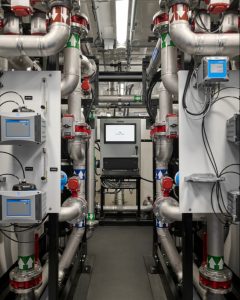
Laminar Water’s mobile treatment system is designed for remote assistance. The containers are equipped with cameras to allow the company to help operators via video if needed, and for operators to keep an eye on the unit when away.
Some of the other display screens also offer educational and instructional information about the system’s components. Kent calls it a conduit for all the information about the design. The controls design is another point of pride for the whole team, Kent says. “We wanted the biggest high-quality screen we could fit and the best industrial computer we could find, because operators have to live and breathe with this terminal.”
Canadian-made quality
Kent says Laminar Water places an emphasis on premium materials and domestic manufacturing. The company’s modular treatment systems are built entirely from 316 stainless steel, with more than 80% of the system components sourced from Canadian manufacturers. Every unit is designed, fabricated and assembled at Laminar Water’s facility in Cambridge, rather than being outsourced.
The trailers also incorporate several design features intended to improve durability and day-to-day operation. There are door sensors and enhanced floor drainage to help manage spills. The wooden container floors have been replaced with polyurethane-coated steel, similar to the protective lining used in heavy-duty truck beds. Clear sections of overhead piping are positioned above the doorways to give operators a clear view of water flow, making it easier to identify potential issues during operation.
Laminar Water made headlines earlier this year with its contract in the Region of Waterloo, Ontario. The first ultrafiltration (UF) unit ordered is designed to treat water drawn from the Grand River using advanced membrane technology, capable of filtering extremely fine particles. It will add up to 50 litres per second of new treatment capacity by the end of 2026.
Kent added that the Region requested a customized coagulation/flocculation system that will allow them to optimize hydraulic retention time in advance of the UF treatment.
Regional officials say the units are intended to temporarily bypass aging infrastructure at the Mannheim Water Treatment Plant, which is limiting treatment capacity. The mobile systems will allow upgrades to proceed without significantly affecting water flow to customers.
“The Mannheim side stream project is a great example of that creativity and collaboration in action,” says Waterloo Regional Chair Karen Redman. “By leveraging new treatment technologies, including Laminar Water’s filtration system, we are finding practical ways to increase available water capacity more quickly, while longer-term solutions continue to advance.”
Laminar Water is headquartered in Cambridge, Ontario. For more information, visit: www.laminarwater.ca
This sponsored article appeared in the August 2026 print edition of Environmental Science & Engineering Magazine.




