

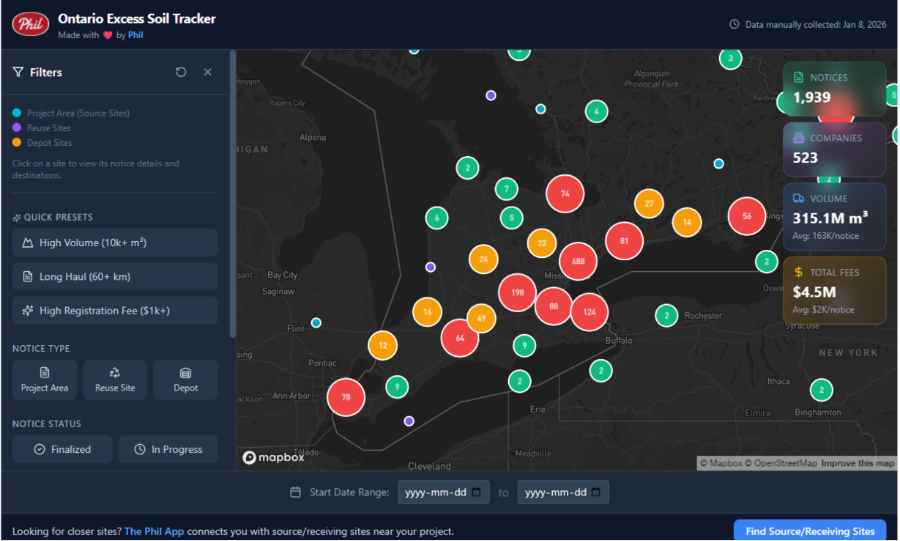
A new online tool is aiming to more clearly highlight information on how millions of tonnes of excess soil are tracked and managed across Ontario.
The Phil App, a Canadian construction technology company, has launched the Ontario Soil Tracker, a free website that endeavours to make public data from the province’s Excess Soil Registry more visual and easily accessible. The platform allows users to graphically explore where soil is coming from, where it is going, and how much of it may be unaccounted for.
The release comes amid growing concern over how excess soil often generated by large construction and infrastructure projects is handled. Each year, tens of millions of tonnes of soil, including contaminated material, are moved across Ontario. Provincial rules require builders to document the origin, destination and composition of this soil, with penalties for non-compliance. There is also a provincial ban on sending soil to landfill set to take effect in 2027.
But according to The Phil App, participation in the registry remains low and enforcement limited.
Subscribe to our Newsletter!
The latest environmental engineering news direct to your inbox. You can unsubscribe at any time.
“Ontario effectively has no data,” said Phil App co-founder Bryan Kerr. “Less than 15% of sites are registered — the program is too expensive and the incentive structure is wrong.”
The company says its new online soil tracker aggregates and visualizes registry data from the Resource Productivity and Recovery Authority (RPRA), allowing contractors, policymakers and the public to assess and understand the excess soils system in Ontario.
The Phil App frames its platform as a step toward greater transparency where data gaps have long made oversight difficult. It operates a marketplace that connects sites with surplus soil to those that can reuse it. According to the company, the some 4,000 users on its platform average haul distances of 29 kilometres, a 55% reduction that cuts costs, truck traffic and emissions.




