

By Mike Sklash and Matt Schroeder
Between 2010 and 2020, there was unprecedented precipitation and storm runoff in the central part of North America. This created numerous problems for municipalities, higher levels of government, industry, and homeowners.
Case study #1 — Loss of use of agricultural land
Dragun Corporation was asked to provide expert opinions on the cause(s) of reported flooding during 2016 in a swale on an agricultural property located near Lake Erie. The plaintiff, who purchased the property in 2010, alleged that the defendant, a neighboring manufacturing plant, changed the drainage on their property. This caused more storm runoff to flow in the plaintiff’s swale that, in turn, prevented the plaintiff from easily moving between the east and west sides of his property. The plaintiff alleged that the swale had never previously prevented crossing with farm equipment.
Natural conditions: We investigated the nature of the swale as a natural groundwater discharge area. We inspected the site and interviewed relevant parties familiar with the local drainage. We reviewed historical topographic maps and determined that the swale was a natural groundwater discharge area, receiving groundwater from the higher surrounding areas. Although there were no continuous records of groundwater levels in the watershed of the swale, regional data was consistent with natural and significant increases in groundwater levels since at least 2010. We attributed the higher groundwater levels to increased precipitation during the decade.
Subscribe to our Newsletter!
The latest environmental engineering news direct to your inbox. You can unsubscribe at any time.
Nearby groundwater elevation and lake level monitoring data were consistent with the increase in base flow. These data support the concept of wetter conditions in the swale due to natural conditions.
Changes to the watershed: The defendant expanded their plant, located north of the plaintiff’s property in early 2016, including the construction of a storm sewer system and a detention pond. Prior to 2016, the defendant’s property naturally had a topographic divide that caused stormwater to flow in opposite directions. However, the plant expansion redirected some stormwater flow from north to south.
The defendant designed their new drainage system to limit stormwater discharge rates to comply with local requirements. The storm sewer system includes a detention pond and all components of the system complied with reasonable and accepted practices for managing stormwater runoff. In fact, the system limits the maximum flow rate to pre-expansion levels and is designed to drain within three days post-storm.
The plaintiff also made drainage alterations on ground sloping to the swale; these changes were intended to facilitate drainage from the slope into the swale. These improvements on the slope actually contributed to greater wetness in the swale, particularly following precipitation events. These changes were made both before and after the 2016 construction at the defendant site.
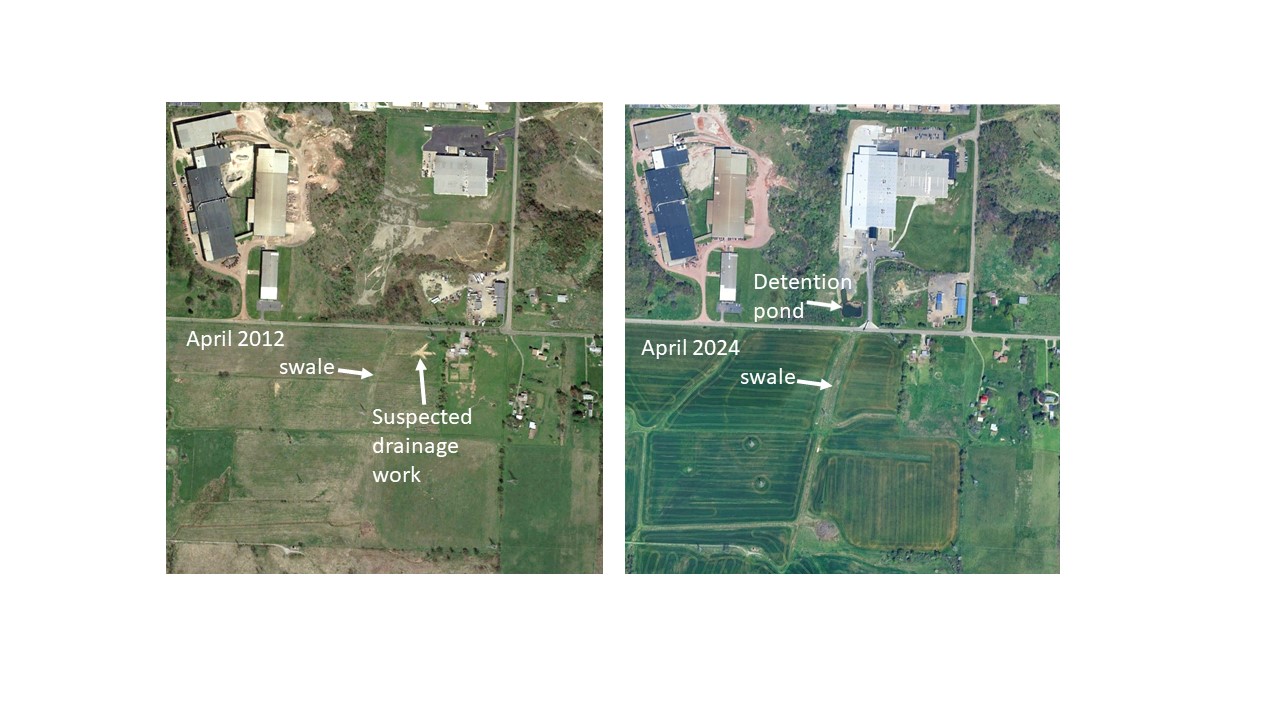
Results: The jury quickly determined that our analysis was reasonable; they recognized that the defendant was not responsible for the flooding in the swale. Our analysis indicated that although the defendant’s drainage modifications and the plaintiff’s flooding problem began at about the same time (and that the plaintiff had not experienced these conditions previously), the two events were unrelated.
The wet conditions along the swale on the plaintiff’s property were caused mostly by its topographic position, regionally wet conditions between 2010 and 2020, and drainage works conducted by the plaintiff on his property.
Case Study #2 — Flooding on a lakeside property
Dragun Corporation was also asked to provide expert opinions on the cause(s) of reported flooding during 2018 at a cottage. The plaintiffs alleged that the defendant increased runoff onto the plaintiffs’ property by reconstructing the lakeside road adjacent to the cottage.
The plaintiffs purchased the property in 2001 and alleged that the property began to flood in 2012. Flooding became severe in 2018 when the roadway was improved. In 2018, the plaintiff’s driveway and garage filled with sediment during storm events.
Natural conditions
Two natural conditions exacerbated storm runoff around the cottage. First, the topography around the plaintiff’s cottage based on topographical maps and our site walk observations indicate the cottage was built in a natural groundwater discharge area. This is similar to the analysis in Case Study #1. In Case Study #2, groundwater from higher surrounding areas in the east discharges into the lake and also causes the water table at the cottage to be close to the ground surface. This condition is conducive to storm runoff generation during precipitation.
Secondly, the period from 2017 to 2020 was exceptionally wet in this region, with 2019 being the wettest year on record. This increased precipitation led to higher groundwater levels and more runoff.
Results
One of the most obvious indications that the flooding at the cottage was not the result of road work was the sediment load in the storm runoff.
Screenshots from videos the plaintiffs made during one of the flooding events in 2018 showed the following:
- Ponding at the ground surface adjacent to the cottage.
- Storm runoff flowing in the west side “valley” curb on the lakeside road flowing from right to left towards the cottage.
- Sediment-laden storm runoff issuing from the unpaved, private road on east side of the lakeside road flowing towards the cottage.
- Sediment-laden storm runoff crossing the lakeside road toward the sandbags that line the entry to the driveway of the plaintiff’s cottage.
The litigation was ultimately resolved by the parties through a private agreement.
Case Study #3 — Flooding over an old drainage way
In this situation, we were asked to provide expert opinions on reported flooding that flowed from a culvert under an unpaved, rural road in front of the plaintiff’s property. The plaintiff alleged that the flooding in June 2017 was due to storm runoff that moved along, and then under, the rural roadway, through a culvert onto their property. The 600-mm diameter culvert was installed many years before the plaintiff purchased the property.
Natural conditions
Two natural conditions help to explain the flooding at this location. First, the topography around the plaintiff’s property, based on topographical maps, wetland maps, and our site walk observations, indicated the property sits in the way of natural surface water drainage. This natural surface water drainage was present long before the plaintiff’s property was developed. Secondly, the watershed was unusually wet during the decade and 2017 was one of the wettest years on record in the area. Both of these factors would promote storm and snowmelt runoff.
Again, the litigation was ultimately resolved by the parties through a private agreement.
Summary
Between 2010 and 2020, unprecedented precipitation and storm runoff in the central part of North America created numerous property-related problems associated with excess water. The common thread in these case studies was that the plaintiffs experienced an excess water problem they had never seen before. They claimed the problem originated because of something the defendants did on/near their property.
In situations like this, typical site-specific data such as historical groundwater level measurements and runoff measurements are not available. As a result, we used classical hydrogeological evaluations, such as recharge versus discharge area analysis, baseflow analysis, and historical groundwater and surface water records from various sources. We also examined time trends in precipitation to determine whether natural conditions in the watershed could have been responsible for the excess water.
In some other cases we have worked on, the excess water was self-inflicted. If the property’s water supply is from a deep aquifer and the property uses septic tanks for water disposal, there will be excess water on the property. If the property is developed, changing the amount of impermeable surface on a property, such as roof areas and pavement, will create excess water.
Mike Sklash and Matt Schroeder are with Dragun Corporation. Email: msklash@dragun.com, mschroeder@dragun.com
This article appeared in the June 2025 edition of Environmental Science & Engineering Magazine.




