By Myriam De Ladurantaye-Noël, Caroline Dale and Marc Laliberté.
Regulations in Canada are such that mines are generally not allowed to discharge water acutely toxic to specific species of fish such as the rainbow trout (Oncorhynchus mykiss), the fathead minnow (Pimephales promelas) or invertebrates such as Daphnia magna. In addition, discharge limits are slowly being tightened due to increasing environmental concerns.
Treatment for the removal of metals, nitrogen such as ammonia, nitrate and nitrite, as well as cyanide compounds such as cyanide, cyanate and thiocyanate, is often required prior to discharge to meet regulatory standards. In addition, most mining sites possess waste rock stacks and tailings ponds, which contain contaminated water due to surface run-off. This contaminated water can be stored in ponds in the cold for extended periods, thus requiring a robust water treatment plant capable of handling seasonal water temperature variations down to <5°C.
Biological treatment has been used for many years to remove carbon sources and nitrogen from municipal effluent, even in cold temperatures. There is a growing need for nitrogen removal from mining effluent. Laboratory and pilot-plant studies have confirmed that biological nitrification and denitrification could be sustained for mining effluent at very low temperatures (<5 °C). Long-term results are now becoming available from full-scale installations.
Subscribe to our Newsletter!
The latest environmental engineering news direct to your inbox. You can unsubscribe at any time.
The MBBR process
The moving bed biofilm reactor (MBBR) is a fixed-film biological treatment process, which utilizes a high-density polyethylene carrier as biomass support. These carriers provide a highly protected surface area for biofilm development. They have a density slightly lower than water, and are continually moved using air in aerobic systems and mechanical mixing in anoxic systems.
Extensive studies were undertaken on municipal and industrial (mining) wastewater to demonstrate prolonged operation at low temperature (0.5 °C – 5 °C for three months) for nitrogen removal. Additional tests have been conducted for various mining sites to validate such efficiency, not only on nitrification, but also on biological cyanide compounds degradation and its impact on the mine effluent toxicity.
Nitrogen removal rates in a biofilm system have been shown during these studies to be highly dependent on temperature. Typically, the design of a biological treatment will be done on the lowest water temperature, to ensure that there is sufficient capacity to achieve treatment under the worst conditions. In Canadian mine operations, the minimum temperature at which nitrogen removal is required will frequently be below 5°C.
The chemical composition of a mining effluent will vary depending on the mining operations and the ore being processed. A full effluent characterization is therefore required prior to the design of the treatment plant. The main contaminants of concern to be addressed using a biological treatment are:
Ammonium and nitrate – These are usually found in mining effluent when explosives such as ammonium nitrate fuel oil (ANFO) are used for blasting.
Cyanate (OCN-) – Cyanate comes from the detoxification process of the gold leaching process. This cyanide compound is not toxic to mammals and birds but is lethal to Daphnia magna. In a biological treatment, it is hydrolyzed to ammonium and bicarbonate.
Thiocyanate (SCN-) – Thiocyanate is the product of the reaction between cyanide and pyrite. It is not toxic at the concentration usually found in gold mine effluent. It is easily biodegradable and results in the production of ammonium. The biomass yield of the bacteria responsible for thiocyanate is low, but once the biomass is fully developed, it is very resistant and will dominate the biomass in the biological treatment. These bacteria are in strong competition with the nitrifying bacteria. Therefore, oxidation of thiocyanate becomes a priority upstream of any nitrification process as it will inhibit ammonium and nitrite removal.
In all cases, metal concentration must be addressed upstream as copper will inhibit biological treatment if present at a high enough concentration. If present, copper is usually removed using a physico-chemical process.
Case Study – The Eleonore Gold Mine
In 2012, Veolia was hired to design and build a water treatment plant for Newmont’s Eleonore gold mine in northern Quebec. Completed in 2013, it used a metal precipitation reactor and a high rate ballasted flocculation clarifier, to remove suspended solids, metals (copper and iron) and arsenic.
In 2015, mine effluent was still periodically showing toxicity to rainbow trout and greater daphnia, even when all metal concentrations were below regulated levels. The suspected cause of toxicity was a combination of cyanates and ammonia.
Laboratory and pilot testing
Veolia proposed to add an MBBR to the water treatment plant to hydrolyze the cyanates and oxidize thiocyanates and the ammonium to nitrate by biological means. Laboratory testing had been conducted to confirm that the process could eliminate the effluent toxicity.
However, laboratory testing does not replicate loading and temperature variations. For this reason, a pilot plant was installed and operated from the fall of 2015 through the winter of 2016. It successfully demonstrated that the water after treatment was no longer toxic, even when the effluent was cold, and confirmed optimal reactor configuration for full-scale design.
During the laboratory and pilot studies, it was demonstrated that the removal rates are controlled by regulating the concentration of dissolved oxygen, pH (by alkali dosage) and carbon dosage for the denitrification stage. The control of these three operating parameters led to higher removal rates in a well-established system. This allowed process performance to be maintained under a higher load or at a lower temperature.

Full scale installation
Following the completion of the pilot testing, a full-scale plant, without the denitrification step, was implemented. Mine effluent is first treated for metal removal. Clarified water then flows to the biological treatment, which is composed of two aerated reactors with pH control. Finally, the biologically treated effluent goes to a final clarifier for oxyanion (arsenic) and suspended solids (sloughed biomass) removal, prior to discharge to the environment. The whole treatment chain is designed to operate year-round.
The key features of the original design for the biological treatment developed with the laboratory and validated with the pilot trial are:
- Biological oxidation of SCN- and hydrolysis of OCN- in a first reactor;
- Nitrification in a second reactor;
- Possibility of adding a denitrification reactor if required for complete nitrogen removal;
- Using a heat recovery system (better recovery of the biological treatment after bacteria die-off, faster biomass development during start-up, more flexibility of operation if there is an unexpected peak load outside the warm season).
The biological treatment capacity at the Eleonore mine is 147 kg N/d of cyanide species (17% as cyanide, 56% as thiocyanate, 27% as cyanate) and 462 kg N/d of ammonium, measured at 8°C. At the present time, no nitrate removal is required.
The MBBR biological treatment was started in summer 2017 and the performance test was completed in November of that year. Since then, the process has been operating continuously with data collected twice per day.
Results from the first 30 months of operation
The wastewater plant has been closely monitored since its commissioning in order to learn more about its capacity in various operating conditions. The following are the main findings.
The first reactor of the biological treatment targets the oxidation of the thiocyanates and hydrolysis of the cyanates. The oxidation of thiocyanate established itself rapidly and has been stable in all operating conditions, even in cold water temperature (down to 2.7°C).
Hydrolysis of cyanates has been much slower to establish. Cyanates are not chemically stable and hydrolyze to ammonium and bicarbonate. However, at neutral pH and cold temperatures, the hydrolysis rate is extremely slow. Thus, the process relies mainly on biological degradation of cyanate. It required nearly six months to achieve 80% removal, and one year after start-up there was still improvement.
After 30 months of operation, cyanate hydrolysis is now nearly complete in the first reactor, improving from roughly 50% of the cyanates leaving R1 in November 2017 to roughly 20% in 2019. An overall cyanate removal of over 90% was achieved after nine months of operation. This shows that the bacteria that degrade OCN- are slow to develop, but eventually grow. It is also shown that these bacteria are developing well, even in cold water conditions. Water temperature has no observable impact on the cyanate removal for the whole duration of the project. The nitrification rate is known to be highly dependent on the water temperature. (See Figure 1)
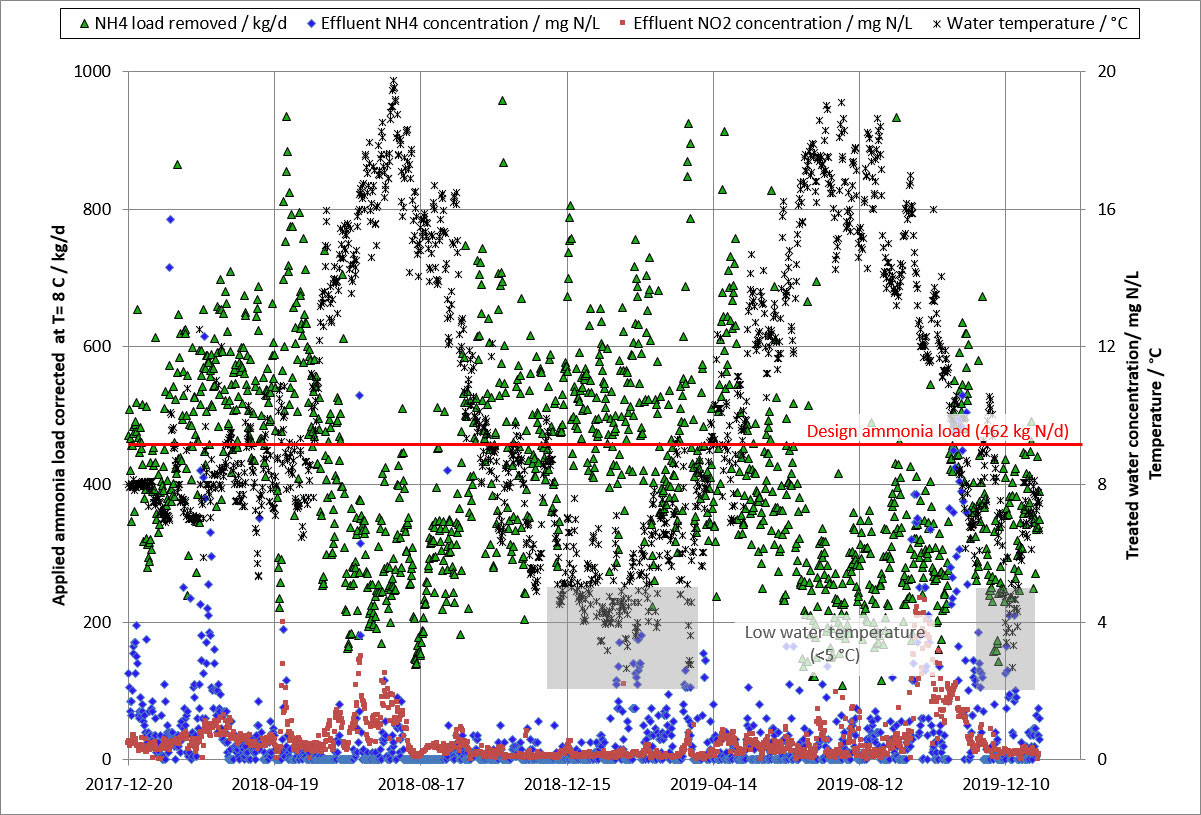
The plant is meeting the design criteria of oxidizing 462 kg N/d of ammonium, exceeding this value for extended periods. Biological treatment is operating close to the design criteria, but it was shown to be limited by pollutant loading more than global capacity, since the effluent quality remains excellent.
The first winter was successfully operated at the design temperature of 8°C. In subsequent winters, the temperature was allowed to drift down naturally to reduce operating costs. The process was closely monitored for process performance and mechanical stability. The process achieved complete nitrification with water temperatures as low as 3°C without any spike in nitrite or ammonium in the effluent. This was corresponded to near the minimum influent temperature without heating.
When the temperature dropped below 3°C, operators turned on the heater as a precaution to prevent any risk of mechanical freezing in exterior piping and the field erected tanks.
In September 2019, the mine experienced a significant rainfall event and required an immediate discharge up to the hydraulic capacity of the system. Although the ammonia load was similar, the flow was doubled in 30 minutes. The process experienced a short-term increase in effluent ammonia and nitrite values. However, concentrations remained below toxic levels. After the event, the process re-established naturally without intervention. This demonstrates the robustness and flexibility of the biological treatment.
Since the completion of the performance test, the mine has passed all lethality testing on both the greater magna and the rainbow trout, even when operating at a temperature below 5°C for several months.
Myriam De Ladurantaye-Noël, Caroline Dale and Marc Laliberté are with Veolia Water Technologies. This article appears in ES&E Magazine’s February 2020 issue.