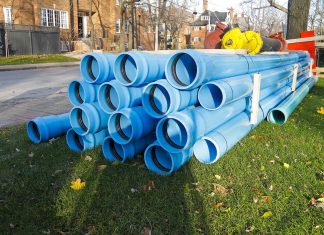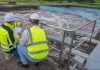


Update: In the first post-construction monitoring visit, minnows were seen upstream of the culvert. Juvenile Rainbow Trout and Creek Chub (some gravid) were found in the upstream channel.

“In addition to those two species,” said Country Beneteau who is monitoring the stream, “We also found White Sucker using the new downstream plunge pool – maybe waiting to traverse the culvert? All very exciting.”
By Ray Wilcock
Throughout North America, perched culverts and similar hydraulic impasses represent a big problem for migrating fish. Perched culverts are ones with an outlet elevated above the downstream water surface. “Fish ladder” is a term used to describe fishway conveyances intended to help alleviate this difficulty. They generally consist of a stepped series of sequentially elevated water pools, separated by weirs or baffles. Replacing a perched culvert is rarely an economically viable solution.
Despite the fact that these obstacles are widespread, little work has been done to scientifically analyze the performance of existing fish ladders in order to improve them.
Subscribe to our Newsletter!
The latest environmental engineering news direct to your inbox. You can unsubscribe at any time.
Under the auspices of the Natural Sciences and Engineering Research Council of Canada (NSERC), a small group of concerned industry colleagues has been collaborating on a project to design and test an innovative corrugated steel pipe (CSP) fish ladder that will enhance the safe passage of migrating fish. Following the analytical and design stage of the project phase, the first prototype has now completed its first field trial.
Overseeing this project are: Dave Penny, Corrugated Steel Pipe Institute (CSPI); Jason Duguay and Jay Lacey, University of Sherbrooke; and Ken Hannaford, Government of Newfoundland and Labrador.
The idea for this research project came about in 2012, when Penny described a concept that Hannaford had for an innovative and improved fish ladder. Penny had learned of this while showing him how using polymer coated structural plate corrugated steel pipe would offer a great base for fabricating these structures. Its corrugations naturally reduce the velocity of water flowing through it, particularly along the edges of the pipe. In fact, the deeper the corrugations, the greater the decrease in velocity.
Previous solutions have been devised to address the problem, including Denil fish ladders. Inside these, numerous metal fins act as deflecting barriers to slow water flow. However, the fins have sharp edges and, if poorly configured, can create excessive turbulence in the pools. Moreover, they provide only small zones of calmer water that fish need for resting, before they proceed to the next pool. Sharp baffle edges and excessive turbulence can injure or even kill fish, especially those that are exhausted from swimming against the combined forces of gravity and flowing water.
Unfortunately, many of these types of fish ladders are ineffective, non-permanent and non-portable devices, and can become plugged with debris, branches, etc.
Fish Ladder Research and Development
Penny, Lacey and Duguay collaborated to secure funding from NSERC, which promotes and supports scientific innovation and collaboration among academic experts and industry.
“We needed funds to support our work and purchase numerical modeling software to determine the effects of specific design changes on water velocities and turbulences within the fish ladder,” explains Duguay.
The team had to ensure that its new design could develop spatial distributions of water velocity and turbulence similar to those of other designs recommended by the Department of Fisheries and Oceans Canada (DFO). They employed a 3D computational fluid dynamics program to analyze and design a baffle that would deliver equal or better results, while providing easier, safer fish passage over a wide range of flow rates.