
By David Nesseth
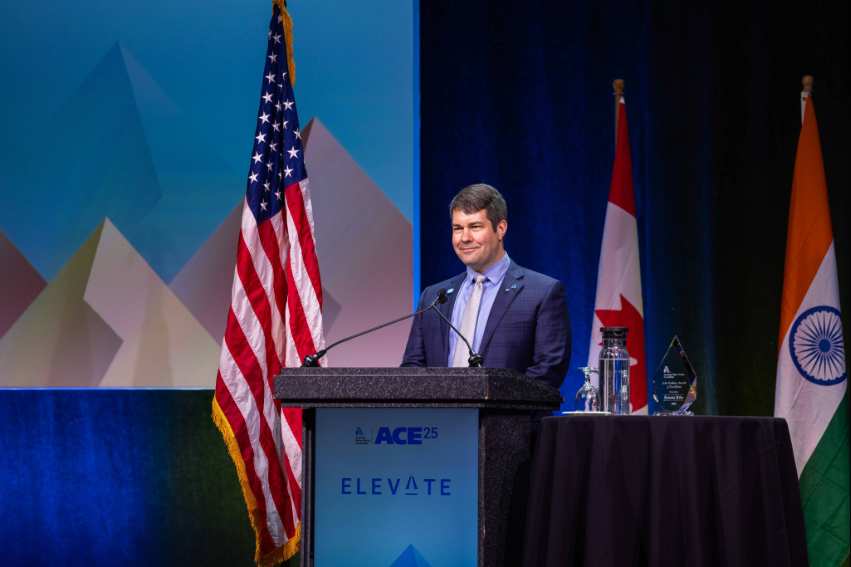
When he begins his presidential term next June, T.J. Stroebl will be the rare American Water Works Association (AWWA) president whose career was built outside a utility, or consulting engineering firm.
Stroebl ran for president-elect at the start of 2026 and won at AWWA’s winter board meeting in Vancouver. His path to the role has been shaped by technical work, sales, association leadership and a career involving both municipal and industrial water treatment.
Stroebl’s presidency will follow that of current president Brent Tippey, who took over in June at AWWA’s 2026 Annual Conference and Exposition in Washington, D.C.
Subscribe to our Newsletter!
The latest environmental engineering news direct to your inbox. You can unsubscribe at any time.
A DIFFERENT ROUTE TO THE PRESIDENCY
After graduating from the University of Minnesota in 2005 with a degree in chemical engineering, Stroebl began his career as an applications engineer at Tonka Water. But mentors soon encouraged him to consider sales, a move that initially felt unfamiliar.
“I didn’t know anything about sales, or really what that was. I was entrusting the mentors I’ve had over the years and took the risk,” Stroebl told Environmental Science & Engineering Magazine. “They knew I had technical capabilities, but that I could also talk to people too.”
Those mentors also saw the reliability and work ethic that would later draw him deeper into AWWA. Stroebl previously served three terms on AWWA’s Manufacturers/Associates Council (MAC), as vice-chair and council chair. The council serves as a bridge between commercial service providers and other water professionals, representing consulting engineers, manufacturers, distributors, contractors and other industry partners.
His background makes Stroebl an uncommon choice for the association’s top volunteer position, as he brings the perspective of a technology and service provider. “I think that in itself is an important message to be sent. And I’m proud to represent that community,” he said.
Stroebl believes that perspective is increasingly valuable as utilities work more closely with manufacturers and technology companies to tackle issues, such as PFAS, water reuse, digitalization and industrial water management. His experience spans both process engineering and drinking water treatment, exposing him to municipal utilities and industrial operations.
He is currently Market Development Leader at Kurita America, where he explores opportunities in industrial and municipal markets for technologies, such as PFAS treatment and water reuse. Before committing to the AWWA role, Stroebl worked with Kurita to determine how he could balance the added workload, which he estimates could account for roughly 30% of his time.
Part of that discussion involved making the case that AWWA’s work is not limited to municipal drinking water systems, but that it reaches across the broader water sector. “I had to create the case that this is all our verticals,” says Stroebl, noting that some people “silo” AWWA as solely municipal.
“The reality is that around 80–85% of our industrial customers are using water from public utilities, or they’re sending their wastewater to a publicly-owned treatment works. So, there is an interconnection.”
That interconnection between public utilities and industrial users is a theme Stroebl returns to often. It also helps explain why he believes AWWA’s leadership role is growing more complex.
KEEPING CANADIAN MEMBERS CONNECTED
While the Canadian membership is less than 10% of AWWA’s overall membership, member utilities serve over 50% of Canadian residents. The first Canadian Section was established in 1916, and today there are five AWWA Sections across Canada. Canadian members serve throughout the association’s leadership structure, councils and committees. A Canadian Affairs Committee helps ensure Canadian perspectives are represented and heard.
In 2025, Stroebl wrote about the Build America, Buy America Act, a domestic procurement preference for federally funded infrastructure projects in the U.S. He says such policies can have consequences beyond the U.S. border.
“That can have an impact on Canadian members, whether they need to reshore manufacturing, or bring manufacturing here,” he said.
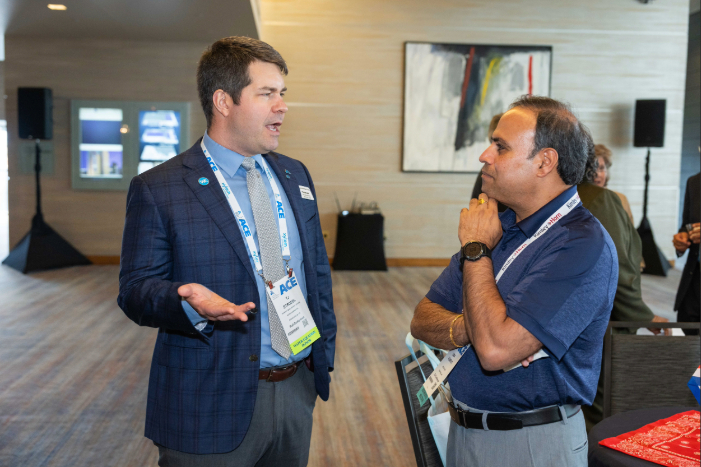
Stroebl pointed to several AWWA efforts designed to strengthen engagement with Canadian members, including the Ontario Water Works Association’s NextWave Conference held in Niagara Falls in May 2026.
NAVIGATING THE PFAS ERA
In his role at Kurita, Stroebl is also watching how PFAS treatment markets continue to evolve. He says municipal PFAS treatment has been driven largely by regulation, but he expects industrial users will increasingly face similar pressure as regulators and utilities look further upstream.
“As municipal wastewater plants come under greater scrutiny, we expect to see more upstream tracing of PFAS sources and stricter limits placed on industrial dischargers. For customers, that means the market is moving quickly, and our role is to help them understand what is coming, reduce uncertainty, and prepare for the next wave of requirements.”
Kurita recently received the Distinction Award for Water Technology Company of the Year at the Global Water Awards 2026, hosted by Global Water Intelligence, with recognition tied in part to its PFAS collaborations.
At the same time, PFAS has become a major policy file for AWWA. The association is directly involved in a petition for judicial review of the U.S. Environmental Protection Agency’s PFAS drinking water rule. Despite the litigation, Stroebl says part of AWWA’s role is to continue providing utilities with tools and guidance, since they still need to work toward rule compliance.
As Stroebl looks ahead to his AWWA presidency, he says issues such as climate resiliency, infrastructure funding gaps and cybersecurity will also remain priorities. But his industrial experience has also sharpened his view of how fast water demands are changing for utilities.
It’s a perspective shaped by two decades working on both sides of the water sector. Stroebl hopes this will broaden the conversation as he prepares to lead AWWA into its next chapter.
David Nesseth is a contributing editor with Environmental Science & Engineering Magazine. Email: david@esemag.com
This article appeared in the October edition of Environmental Science & Engineering Magazine: