By Patrick Murphy
Water treatment plant operators often dedicate substantial time and manpower to manual tasks, such as verifying chemical metering pump activity, logging residuals and other routine checks.
Beyond the added labour burden, this approach can leave a critical blind spot in plant operations. For example, between manual checks, a pump can drift from its setpoint, lose prime, or fail entirely. This may go undetected for hours, until a downstream problem, such as a spike or drop in chlorine or pH finally signals that something has gone wrong.
Integrating metering pumps into a SCADA system offers real-time visibility and direct control over chemical feed processes. When a pump is connected, operators can monitor what it is being told to do and what it is actually doing. They can then take corrective action as needed, without ever having to leave the central control room.
Subscribe to our Newsletter!
The latest environmental engineering news direct to your inbox. You can unsubscribe at any time.
SCADA connectivity yields three major benefits. Firstly, operators no longer need to perform manual rounds for simple status checks or manual logging. This frees up staff for more critical maintenance tasks and eliminates time spent travelling between sites.
Secondly, precise integration allows the system to inject exactly what is needed, based on real-time demand, preventing costly chemical over-dosing.
Finally, instead of relying on tedious manual logs, that can be lost or inconsistently used, SCADA provides a continuous, auditable record of dosing performance. This data serves as supporting evidence for inspectors that the plant has remained within regulatory limits at all times.
NAVIGATING AGING EQUIPMENT
One of the most common misconceptions is that a plant must undergo a massive capital project to begin SCADA integration. In reality, integration can be a phased process. Most treatment plants manage a mix of legacy and modern equipment. Even older pumps often feature a 4–20 mA input for basic speed control.
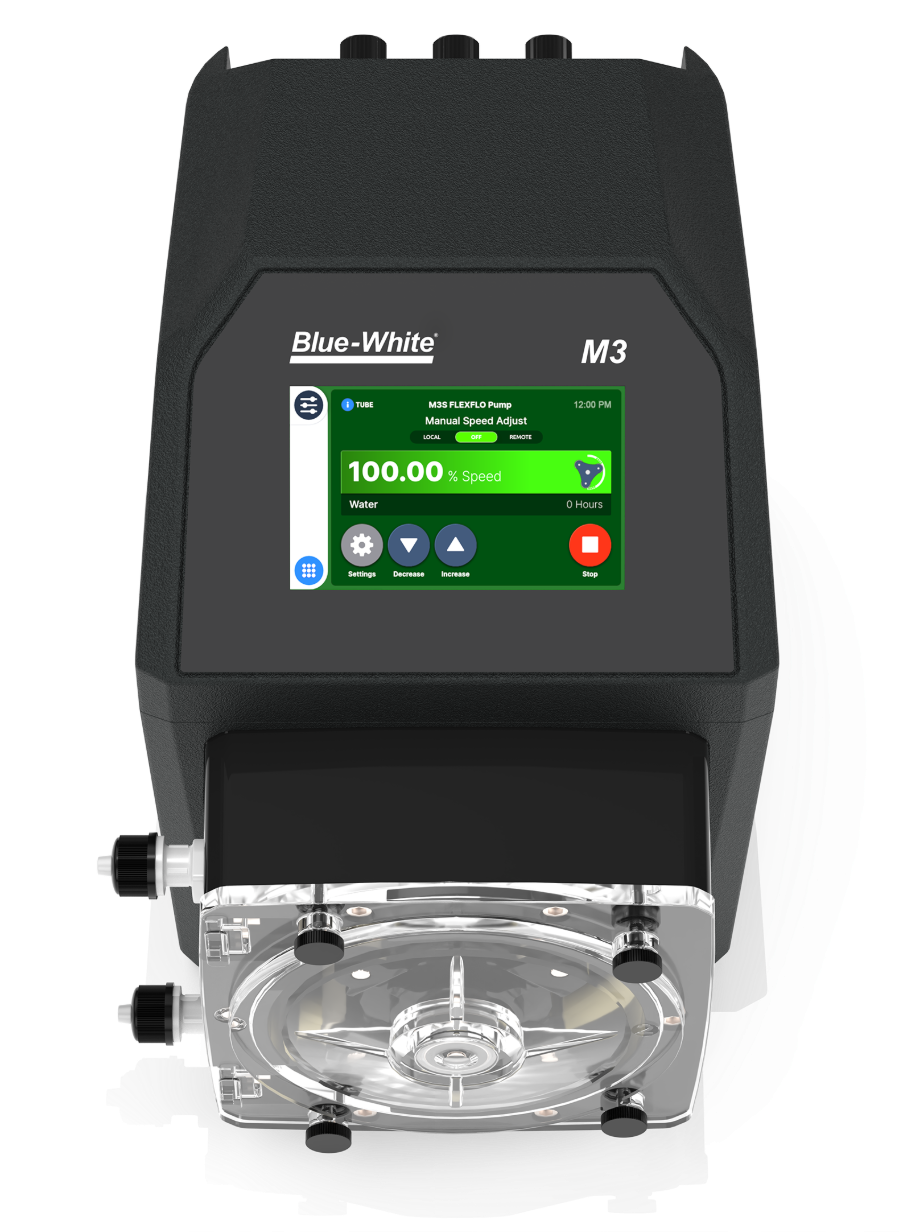
As plants upgrade, they can replace aging units with integration-ready pumps, such as Blue-White’s FLEXFLO® peristaltic, or CHEM-FEED® diaphragm lines. These smart pumps ship with native support for both analog and digital protocols. If a SCADA system is already in place, connecting a new pump is often more about wiring and configuration than custom engineering.
CONTROL LOOPS
To maximize the value of an integrated pump, it is essential to understand the different types of control loops that SCADA enables:
- Open loop – This is the simplest level, where an operator sets the pump’s speed, and it runs at that speed, regardless of external factors.
- Flow-paced (closed loop) – In this scenario, a flow meter sends data to the SCADA system, which then automatically adjusts pump speed to match the flow rate in the pipe. This is a more immediate and responsive way to manage dosing.
- Compound loop – This represents the highest level of integration. It uses a secondary check, such as an ORP or pH analyzer, to provide feedback. If the flow rate increases, but the analyzer detects the residual is already too high, the system will self-correct and slow the pump down to prevent over-dosing.
CHOOSING SIGNALS AND DATA POINTS
Deciding how to connect a pump depends on the desired level of control and budget. Analog signals like 4–20 mA are simple to wire, but are limited in the data they can provide.
For deeper insights, industrial protocols such as Modbus RTU/TCP or EtherNet/IP are preferred. While these require a more complicated initial setup, they provide high-speed, noise-resistant communication. These digital connections allow operators to track critical data points beyond just flow rate, such as totalized volume, tube/diaphragm wear data, and leak detection.
PROACTIVE MAINTENANCE AND LONG-TERM VALUE
Integrating chemical metering pumps into a SCADA system changes the fundamental approach to maintenance from reactive to proactive. By utilizing real-time data, operators can catch problems like a tube failure early by monitoring revolution alarms and wear indicators. This prevents emergency maintenance and unscheduled downtime.
Beyond daily operations, data gathered by SCADA is invaluable for future capital planning. Plant managers can use historical performance data to justify budget requests for new equipment, showing exactly how much chemical has been saved, or how many staff hours have been reclaimed through automation.
While the transition from manual to connected systems requires an upfront investment in time and training, the return on investment is significant. By leveraging modern metering pumps and SCADA integration, treatment plant operators can eliminate reliance on institutional knowledge. Instead, they will have real-time monitoring and automated alerts, ensuring consistent operations regardless of who is on shift.
Patrick Murphy is VP of Operations at Blue-White Industries Ltd. For more information, email: sales@blue-white.com
This article appeared in the August 2026 edition of Environmental Science & Engineering Magazine.