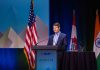
A Newfoundland and Labrador student has won the 2026 Stockholm Junior Water Prize for developing an autonomous robot that uses artificial intelligence and magnets to remove plastic from water while avoiding harm to marine life.
Moroti Adegboyega of St. John’s received the international award on August 25 during World Water Week in Stockholm, Sweden. The prize was presented by Crown Princess Victoria of Sweden.
Adegboyega’s winning project, called Ecoferroquatics, uses an AI-guided robot, biodegradable ferrofluid and magnets to identify and collect plastic particles from water.
Ferrofluid is a liquid containing magnetic particles that can be manipulated using a magnetic field. The system is designed to selectively capture plastic while reducing the risk of trapping or injuring aquatic organisms.
Subscribe to our Newsletter!
The latest environmental engineering news direct to your inbox. You can unsubscribe at any time.
During testing, the technology performed better than a simple sieve at collecting some of the smallest plastic particles, including material approaching the microplastic scale, according to organizers.
The project was developed as an alternative to cleanup methods such as nets, filters and trawlers, which can require significant manual labour and may also capture or disturb marine life.
Ecoferroquatics: A Novel Autonomous Plastic Cleanup Platform Integrating AI (PDF)
Plastic waste can break down into progressively smaller particles after entering aquatic environments. These particles can be ingested by wildlife and potentially move through food webs while carrying or absorbing other contaminants.
For validation, a controlled proof-of-concept study was done in a pool environment against multiple plastic polymers of varying sizes. After nine trials, the robot had 51.85% removal efficiency and could collect 1.73 pieces of plastic per minute. The system outperformed a preliminary sieve-based baseline for microplastic-scale particles, illustrating the pass-through limitation of coarse mechanical screening.

Adegboyega, who is heading into Grade 12 at St. Bonaventure’s College, was selected from national winners representing more than 40 countries. He received a prize of US$15,000 and a water-themed trophy.
The Water Environment Association of Ontario (WEAO) has also been following Adegboyega’s journey closely.
Before he travelled to Stockholm, WEAO interviewed him about the development of Ecoferroquatics, the challenges he encountered while building the prototype, what representing Canada meant to him, and where he hopes the technology could go next.
He began the project with a strong background in software and coding and learned much of the robotics, water science and environmental engineering required for Ecoferroquatics as the project evolved. In his conversation with WEAO before travelling to Stockholm, he described the science behind the project.
“Essentially, in simple terms, I can turn plastic magnetic,” Adegboyega told WEAO. “And once they are magnetic, all it takes is a simple magnet to pull them out of the water.”
He also spoke about looking forward to receiving feedback from international water
experts rather than treating Stockholm as the end of the project.
“I want them to critique my project,” he said.
The Stockholm Junior Water Prize has been held internationally since 1997 and recognizes water-related research by students between the ages of 15 and 20. Projects can address water quality, water resources, water and wastewater treatment, water protection and other related issues.
Canada has previously produced several winners.
In 2022, Annabelle Rayson of Sarnia, Ontario, received the prize for research examining how biomanipulation and certain zooplankton species could be used to help prevent harmful algal blooms. Rayson began investigating the issue after seeing the effect algal blooms were having on her father’s commercial fishing work.
Canadian student Hayley Todesco won in 2014 for research involving sand filters to treat oil-contaminated water, while Alexandre Allard and Danny Luong won in 2010 for work involving bacteria capable of degrading polystyrene.
Judges also recognized two other projects during this year’s competition.
Hungary’s Laura Ivanka received the Diploma of Excellence for developing and testing a system intended to help divers collect macroplastics from marine environments.
The People’s Choice Award went to Basmala Diab of Egypt for a project that converted rice and corn straw into activated carbon for use in microbial fuel cells. The system is intended to improve wastewater treatment while generating electricity through naturally occurring microorganisms.